
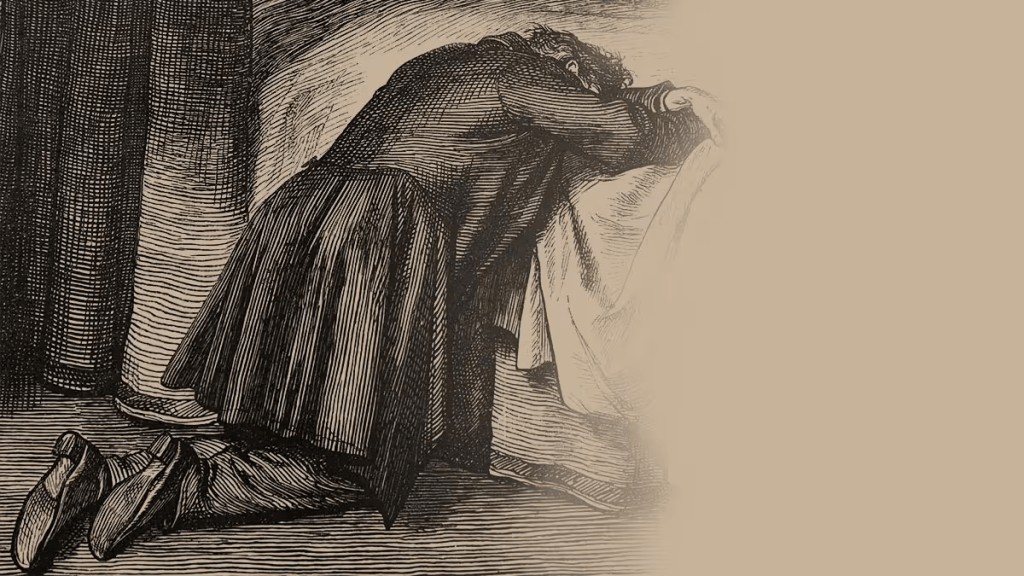
There is a box in my closet that I open carefully.
Not because it’s fragile. Not because it’s heavy. But because I know what’s waiting on the other side of the lid — a smell so specific, so stubbornly, impossibly him, that opening it feels less like accessing storage and more like stepping through a door I can never fully walk through.
It’s my dad’s box. He’s been gone three years now. And somehow, against all logic, against the laws of time and fabric and the universe doing its relentless, indifferent thing — his shirts still smell like him.
I don’t know how to explain it. I also don’t know how to not cry about it. Both of those things are true at the same time, which is basically the entire experience of grief in a nutshell.
Here’s something nobody tells you when you lose someone: laundry becomes complicated.
Not in the way it’s normally complicated — the lost socks, the shrunken sweater, the eternal mystery of where the second dryer sheet goes. No. It becomes complicated in the way that a single, ordinary garment can suddenly carry the full, unbearable weight of a person.
You find yourself standing in front of a washing machine with a flannel shirt in your hands, and you simply… cannot do it. The wash cycle that has never failed you, the one that has cleaned grass stains and motor oil and whatever that was on the holiday tablecloth — that machine suddenly feels like an act of erasure. A betrayal.
So you don’t wash it. You fold it. You put it somewhere safe. And months later, when you open that drawer or that box or that corner of the closet you’ve been quietly avoiding, the scent hits you like a wave you weren’t ready for, even though you absolutely should have been ready, because you knew it was there. You opened the box yourself. You have no one to blame but you.
And you cry anyway. Of course you do. That’s the whole point.
There’s actually a name for this. Scientists — the ones who study smell and memory and the strange territories where the two overlap — call it the Proustian memory response. Named for Marcel Proust, who famously bit into a madeleine cookie and was instantly transported decades back in time by the smell and taste of it. The olfactory system, unlike any other sense, has a nearly direct line to the hippocampus and amygdala — the parts of your brain that handle memory and emotion. Sight and sound get filtered and processed. Smell goes straight to the source.
Which means a whiff of your father’s aftershave, or the particular way his coat smelled like cold air and something warm underneath it, doesn’t just remind you of him.
It returns you to him. Even briefly. Even just for a second, in the space between inhaling and exhaling.
And then the second passes, and you’re standing in your closet, crying into a flannel shirt, and you realize that grief doesn’t actually get smaller over time. You just get slightly better at not being blindsided by it.
Slightly.
He was right about a lot of things, which is the kind of realization that tends to arrive about three to five years too late.
He was not a still person. The stillness came later, and I’m not going to write about that part. Not today.
Today, I’m writing about the box.
I’m not alone in this. Not even close.
There’s an entire, quiet, largely unspoken community of people who have kept unwashed garments after someone died. Widows and widowers who sleep on the same side of the bed because the other pillow still smells right. Grown children who cannot bring themselves to donate a cardigan. Parents — and this is the one that undoes me completely — who keep a child’s pajamas unwashed, zipped in a bag, preserved like something precious, because they are. Because they are the most precious thing.
There are grief counselors who now specifically address this in their practices. Don’t rush to clear out the closet, they say. There’s no timeline. The scent will fade eventually on its own — you don’t need to accelerate its departure. The clothes aren’t the person, but they hold something of the person, and that’s not delusion. That’s just how scent memory works. That’s just being human.
Even textile conservators — the people who preserve historical garments in museums — understand that smell is part of the artifact. A dress from the 1800s might carry trace notes of the lavender sachets it was stored with, or the cedar of the wardrobe, or something less nameable. They don’t wash those either. Some things are worth keeping exactly as they are.
There’s a particular cruelty to how scent fades.
Unlike a photograph, you can’t make a copy. Unlike a recording, you can’t press play. The scent is housed in the fabric itself — in the volatile organic compounds left behind by skin and soap and the particular chemistry of a person — and it dissipates slowly, impervious to your wishes, indifferent to your grief. The more you handle the garment, the faster it goes. The less you handle it, the longer it lasts, but then you’re not really experiencing it at all, just preserving it, keeping it like a specimen rather than a connection.
There’s no good answer. There is only the box. The careful opening. The moment that costs you something every single time and that you would never, ever give up.
I think about what my dad would say about all of this. About the box, about the crying, about me writing a blog post about his flannel shirts.
He would probably give me a look — the particular look that communicated both you’re being a little dramatic and I love you, kid in the same glance, which was a skill he had perfected over decades.
He wouldn’t have understood why I write about laundry. But he would have understood this: that taking care of things is a form of love. That clean clothes matter. That the ordinary rituals of a household are where most of real life actually happens.
He understood that without ever having to say it. He just did it.
And in the end, that’s what the box is. It’s not a shrine. It’s not an inability to let go. It’s just love with nowhere to go, tucked into a cardboard box in the back of a closet, waiting patiently for the next time I need to remember what he smelled like.
Which will be, I’m fairly certain, the next time I open it.
If you have a box like mine — a drawer, a bag, a shelf with something on it you haven’t been able to wash — you already know everything I just spent the last hour trying to say.
You know it the second that scent hits you.
Keep the box. Don’t rush. Let it be what it is.
Some laundry is not meant to be done.
The Laundry Club Blog — Spinning tales one load at a time. Never fold on your dreams.


Leave a Reply