
There are many reasons a sock may vanish.
The dryer may have eaten it. The dog may have stolen it. A child may have used it as a puppet, a cleaning rag, or a tiny sleeping bag for a plastic dinosaur. It may have slipped behind the washer and entered that shadowy domestic underworld where missing buttons, pennies, hair ties, and one earring from 2014 go to retire.
But sometimes, dear reader, the sock did not vanish.
Sometimes, the sock was taken.
And sometimes, the missing item is not a sock at all. It is a bra. A pair of underwear. A favorite pair of leggings. Something intimate. Something personal. Something you did not leave behind as an offering to the gods of communal laundry.
That is when the ordinary annoyance of missing laundry becomes something else entirely.
A missing towel is irritating. A missing hoodie is suspicious. But missing underwear? That has a different temperature. It crawls up the back of your neck. It makes you look around the laundry room differently. It makes the humming dryer sound less like a convenience and more like a witness.
Because underwear is not just fabric. It is boundary cloth.
It lives close to the body. It carries scent, sweat, warmth, and the private evidence of being a human being. It is the cotton-and-elastic equivalent of “none of your business.” So when someone steals it, they are not just taking property. They are reaching into a private space without permission.
And yes, there is a whole online world where people willingly sell worn socks, underwear, and other intimate items. That exists. Adults do strange little commerce all the time. The internet has taught us that someone, somewhere, will buy almost anything if it comes with a backstory and suspicious packaging.
But here is the important dividing line:
Consent.
Selling worn socks or underwear online is a choice. Stealing them from a washer, dryer, gym bag, dorm laundry room, apartment basement, or clothesline is not. One is a transaction between adults. The other is theft, violation, and possibly part of a larger pattern of predatory behavior.
So let us examine the laundry thief, the fetish marketplace, and the sacred undergarment drawer with the seriousness this topic deserves.
Which is to say: with one eyebrow raised, one laundry basket clutched protectively to the chest, and a deep respect for the phrase “keep your hands off my delicates.”

The Psychology of the Stolen Garment
Laundry is intimate in a way most household chores are not.
Dirty dishes tell people what you ate. Unmade beds reveal that you gave up. Dust says you have a life, or allergies, or both. But laundry tells on the body. It knows where you sweat, what you wore to work, which jeans betrayed you, which shirt you cried in, and which underwear has been demoted to “laundry day emergency status.”
Clothing holds a kind of personal residue. Not in a spooky haunted-object way, although this blog reserves the right to make anything spooky. Clothing is tied to identity, memory, body image, attraction, shame, comfort, and routine. A favorite sweater can feel like armor. A dead loved one’s shirt can feel like a relic. A child’s tiny sock can undo a parent emotionally in the middle of folding.
Undergarments intensify that intimacy because they are hidden by design. They are not public-facing. They belong to the private architecture of getting dressed. They are chosen, worn, adjusted, washed, and put away in spaces that are usually closed off from strangers.
That is why theft of intimate clothing often feels different from regular property theft. The monetary value may be small. The emotional trespass is not.
A person stealing underwear from a laundry room is not usually after luxury resale value. They are not casing the place for high-thread-count briefs like a criminal mastermind of cotton blends. The stolen item matters because of its intimacy. The theft is about access, fantasy, control, or thrill.
Psychologically, intimate clothing can become a symbolic stand-in for a person. It can represent closeness without consent. It can turn a garment into a substitute body. In fetishistic interests, arousal may become attached to objects, fabrics, body-worn items, or specific categories of clothing. That does not automatically mean someone is dangerous, disordered, or criminal. Human desire is weird, and most people who have unusual interests are not out committing crimes.
But again, the issue is not the object.
The issue is the boundary.
A fetish becomes a problem when it involves distress, impairment, coercion, non-consent, or harm to others. The difference between “I bought this from a consenting adult online” and “I stole this from a stranger’s dryer” is not a technicality. It is the entire moral and legal universe.
One involves agreement.
The other involves taking.
The Internet Sock Bazaar
Let us talk about the online marketplace for dirty socks and underwear, because apparently the internet looked at every possible human desire and said, “Yes, we can monetize that.”
There are websites and informal platforms where adults sell worn garments to buyers who are interested in scent, fantasy, taboo, intimacy, or the idea of possessing something that has been close to another person’s body. The items may be described in detail. How long they were worn. What activity was done in them. Whether they were worn to the gym, to work, to bed, to brunch, or, God help us, “while running errands.”
Capitalism has never once asked, “Should we?” It only asks, “Can this fit in a padded envelope?”
From a psychological perspective, the appeal may involve several things: scent, imagination, taboo, personal connection, secrecy, or object fixation. For some buyers, the garment is less about the actual fabric and more about the fantasy attached to it. The item becomes a prop in a story. A bridge between the buyer and the imagined presence of the seller.
Again, consensual adult commerce is not the villain here. It may be strange to many people. It may make some readers want to bleach their browser history and their eyeballs. But adults are allowed to engage in consensual exchanges that other adults find odd.
The problem comes when someone decides they do not need consent because a laundry room is easier than a website.
That is when we leave the sock bazaar and enter the basement of bad decisions.
The Laundry Room as a Crime Scene
Communal laundry rooms are strange spaces.
They are public-private hybrids. You bring your most personal items into a room shared with neighbors, strangers, college students, building maintenance workers, the guy from 2B who never cleans the lint trap, and at least one person who thinks dryer time is a suggestion rather than a schedule.
The whole arrangement is built on trust. We trust that people will not touch our things unless absolutely necessary. We trust that if someone removes our load, they will do it with the emotional neutrality of a tired adult trying to get their jeans dry. We trust that our socks, bras, underwear, towels, sheets, and questionable pajama pants will remain simply laundry.
But a laundry thief breaks that social contract.
The act may appear small, even ridiculous, from the outside. “It was just underwear.” “It was just socks.” “It was just a few things from the dryer.” That kind of dismissal is exactly why many people do not report it. They feel embarrassed. They worry they will not be taken seriously. They may even blame themselves for leaving the load unattended.
But intimate theft has a different meaning than ordinary missing clothes. It can suggest targeting. It may be repeated. It may escalate. It may be connected to voyeurism, stalking, burglary, or other boundary-crossing behaviors. Not always, of course. But enough that it should not be brushed off as harmless weirdness.
A person who steals a stranger’s underwear is already demonstrating a willingness to violate privacy for gratification, thrill, or compulsion. That matters.
And no, this does not mean every laundry-room goblin is one step away from a true-crime documentary. But it does mean we should stop treating targeted intimate theft like a sitcom misunderstanding.
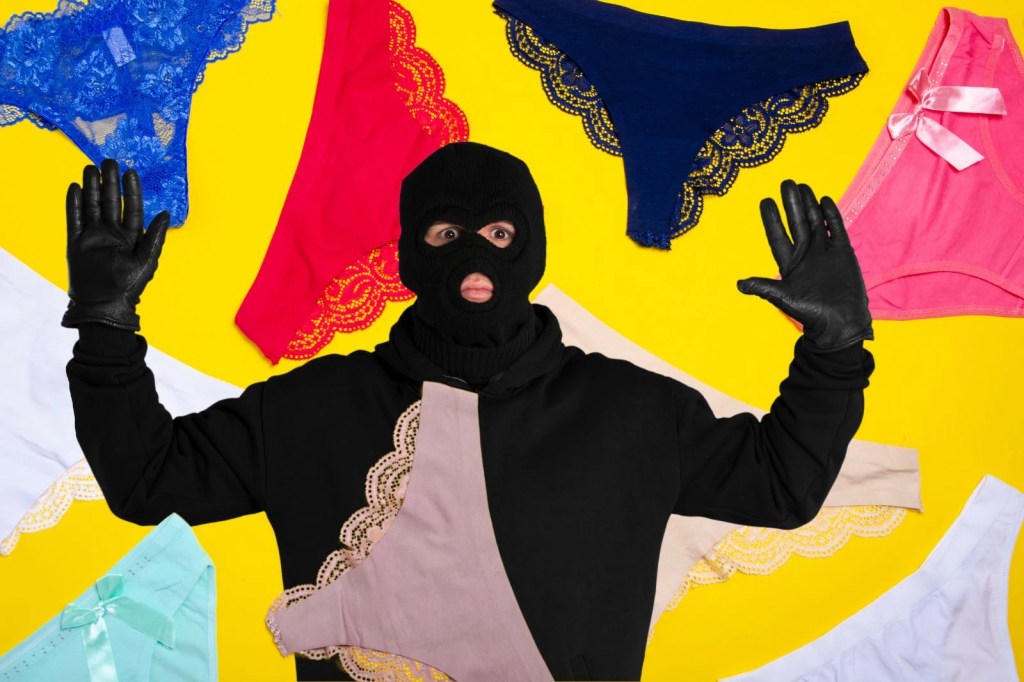
If someone repeatedly steals underwear from shared laundry spaces, that is not quirky. That is a red flag wearing sneakers.
The Sacred Undergarment Doctrine
Now that we have established the seriousness of the matter, let us turn to what I call the Sacred Undergarment Doctrine.
This doctrine is built on one principle:
Your undergarments are not community property.
They are not abandoned treasure. They are not flirtation flags. They are not free samples. They are not part of the “take a penny, leave a penny” economy of the apartment basement.
They are sacred textiles.
They have supported you through workdays, workouts, periods, hot flashes, bloating, bad decisions, good jeans, bad jeans, first dates, last dates, and those bleak Sundays when the only clean pair left is the one that technically fits but spiritually insults you.
They have earned protection.
Not just from the black hole in the dryer.
From people.
So how do we protect the sacred undergarments without turning every laundry day into a neighborhood surveillance operation?
We begin with practical paranoia. The healthy kind. The kind that says, “I am not living in fear, but I am also not leaving my bras alone with a stranger named Kevin and a flickering fluorescent light.”
Commandments for Protecting Thy Delicates
First: Do not abandon the delicates.
Laundry timers exist for a reason. Set one. Respect it. Return before the machine stops if you can. Laundry left unattended too long becomes vulnerable to all kinds of nonsense: theft, removal, damp mildew, impatient neighbors, and the mysterious person who thinks your wet clothes belong on top of the dusty vending machine.
Second: Use a mesh bag.
A mesh bag is not just for protecting lace. It is witness protection for underwear. It keeps small items together, makes them easier to track, and reduces the chance of a rogue pair of underwear escaping into the communal wilderness.
Third: Do intimate loads at home when possible.
If you have access to your own washer or even a small portable unit, consider washing the most personal items privately. Not everyone has that option, and no one should have to hide their laundry to avoid theft. But if communal laundry has already become suspicious, keeping undergarments out of that space can bring peace of mind.
Fourth: Do not ignore patterns.
One missing sock is life. Three missing bras is a situation. If intimate items repeatedly disappear, write down dates, times, machines used, and any details that stand out. Patterns matter. They help landlords, building managers, campus housing, or police take the issue more seriously.
Fifth: Report it.
This is especially important if the theft is targeted, repeated, or involves entry into private spaces. You are not being dramatic. You are documenting a boundary violation. A report creates a record, and records matter when “weird” turns into “ongoing.”
Sixth: Talk to management.
Apartment buildings, laundromats, dorms, and gyms should take this seriously. Cameras, better lighting, working locks, signage, and staff awareness can all help. The goal is not to create a police state around the spin cycle. The goal is to make it harder for creeps to browse dryers like clearance racks.
Seventh: Trust the ick.
Sometimes your body notices the wrongness before your brain prepares the full PowerPoint. If someone is lingering too long, watching loads too closely, appearing at odd times, or giving off basement goblin energy, pay attention. You do not need to accuse everyone who breathes near a dryer. But you are allowed to notice when something feels off.
The Clothesline Problem
Of course, laundry theft did not begin with apartment machines.
Before dryers, the clothesline was the stage. Sheets, slips, bloomers, stockings, work shirts, diapers, towels, and family secrets waved in the wind for neighbors to see. A clothesline could reveal the size of a household, the age of children, the economic status of a family, whether someone was sick, whether a baby had arrived, whether a woman was menstruating, whether mourning clothes were being washed, whether work uniforms were in heavy rotation.
Laundry has always been a little nosy.
A line of clothing outside is practical, beautiful, and vulnerable. It invites sun and air, but it also exposes the private world to public eyes. That is why intimate theft from clotheslines carries its own old-fashioned creepiness. There is something especially unsettling about someone walking through a yard or alley to pluck underwear from the breeze like forbidden fruit.
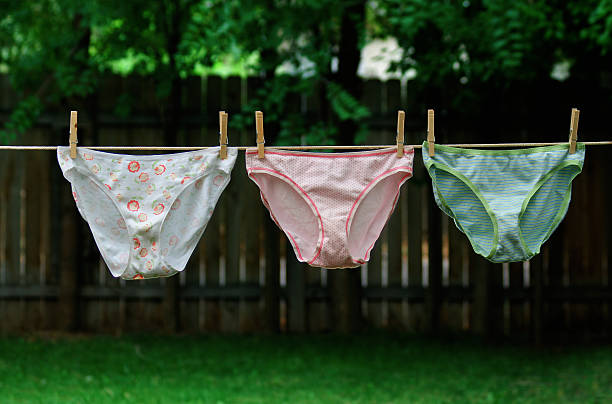
The modern laundry room is just the indoor version of that same vulnerability. Instead of wind, we have tumbling heat. Instead of clothespins, we have coin slots. Instead of the nosy neighbor at the fence, we have the stranger who opens a dryer that is not theirs.
Different century. Same underpants-based audacity.
Why It Feels So Violating
Part of what makes intimate laundry theft unsettling is that it collapses distance.
Most of us rely on invisible walls. Social rules. Politeness. Doors. Drawers. Laundry baskets. The shared assumption that strangers will not involve themselves in our underwear.
When someone steals intimate clothing, they break those invisible walls. They turn something mundane into something sexualized or invasive without permission. The victim may feel watched even if they never saw the thief. They may wonder: Was I targeted? Did this person know which machine was mine? Have they watched me before? Will they do it again? Do they know where I live?
That is why the emotional reaction can be much bigger than the item’s price tag.
The stolen thing is replaceable.
The sense of privacy is not always so easily restored.
This is also why jokes about panty thieves can age poorly when the real-life context is considered. The old comedy version imagines a harmless oddball sneaking off with frilly trophies. The real version can involve fear, surveillance, trespass, escalation, and the sickening realization that someone turned your ordinary routine into their private fantasy.
Humor can still belong here. Obviously. This is The Laundry Club, not a beige pamphlet titled “Garment Safety Awareness for Residents.” But humor should punch toward the absurdity of the thief, not minimize the violation.
So yes, we may call him a sock goblin.
But we still lock the laundry room door.
The Dryer Is No Longer Our Only Enemy
For generations, the dryer has taken the blame.
Every household has accused it. Every laundromat has hosted the ritual: open dryer, remove clothes, count socks, frown, shake towel, look inside drum, question reality. The missing sock has become domestic mythology. We imagine a portal inside the dryer. A lint-lined wormhole. A cotton-hungry beast living just beyond the filter.
But perhaps we have been too generous.
Perhaps the dryer is not the only suspect.
Perhaps some socks are not lost to physics, but to foolishness. Perhaps some underwear did not disappear into static cling but into the pocket of someone who needs therapy, consequences, or both.
This is not to absolve the dryer. It remains suspicious. It has never provided a full accounting of its activities. But we must expand the suspect list.
The black hole may be mechanical.
Or it may have hands.
Final Spin
Laundry has always lived at the border between public and private. We wash our most personal evidence in machines used by strangers. We hang our lives on lines. We fold our days into drawers. We trust fabric to return to us clean, whole, and unbothered.
Most of the time, it does.
But when intimate laundry is stolen, something more than cotton goes missing. Consent goes missing. Privacy goes missing. That quiet expectation of safety goes missing, too.
So protect your sacred undergarments.
Set the timer. Use the mesh bag. Watch the dryer. Report the repeat offender. Do not let anyone convince you that targeted intimate theft is harmless just because the object has an elastic waistband.
And the next time a sock disappears, pause before blaming the dryer.
The machine may be innocent.
The goblin in the hoodie, however, has some explaining to do.


Leave a Reply