
The 1881 Washerwomen’s Strike that left a city staring at its own dirty laundry
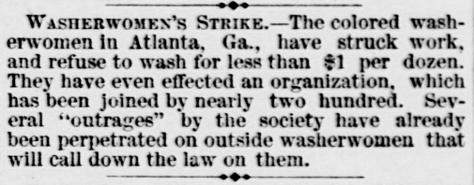
Atlanta wanted to show off.
It was 1881, sixteen years after the Civil War had ended, and the city was busy trying to reinvent itself as something shiny, prosperous and modern. Atlanta was preparing for the International Cotton Exposition, an enormous event meant to advertise the economic promise of the so-called “New South.” Businessmen were coming. Politicians were coming. Investors were coming. Visitors would need hotel rooms, restaurants, pressed shirts, fresh sheets, clean tablecloths and all the little domestic miracles civilized society tends to enjoy without spending much time wondering who actually performs them.
Atlanta was ready to put on its Sunday best.
Unfortunately for Atlanta, the women responsible for washing its Sunday best were getting thoroughly sick of everybody’s shit.
And in July of 1881, they put down the washboards.
Before the Revolt Came Wash Day
There is a certain softness to the way we remember historical laundry.
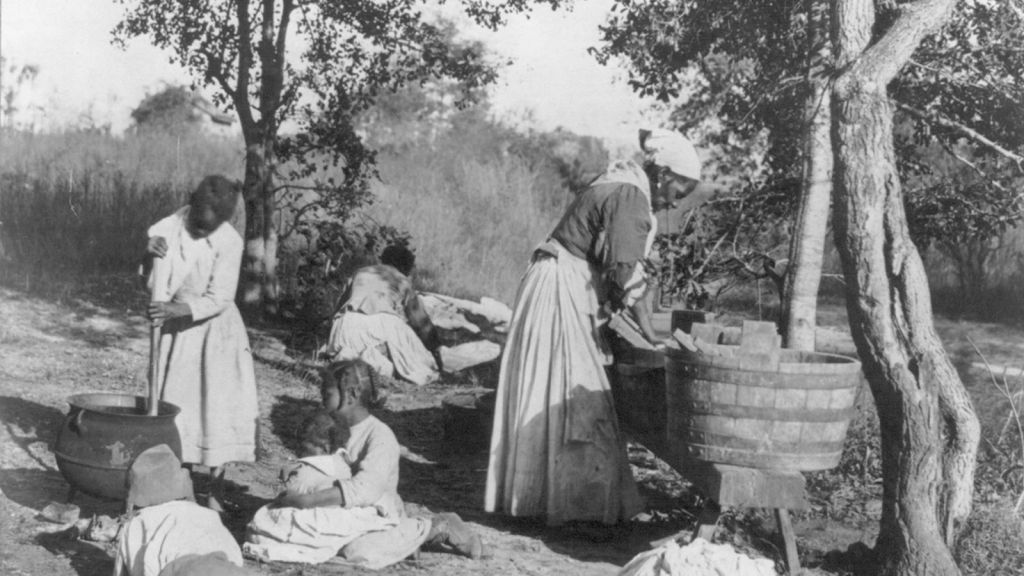
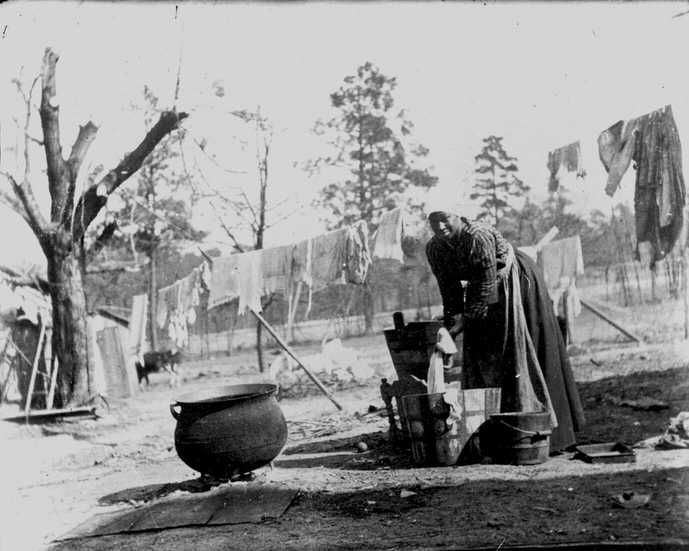
We picture a white sheet snapping pleasantly in the breeze. Maybe a wooden washboard leaning against a galvanized tub. A woman in a long dress standing beneath a clothesline while somebody’s great-grandmother’s secret soap recipe bubbles nearby.
Very quaint.
Very Little House on the Prairie.
Absolute bullshit.
Laundry in the nineteenth century was brutal physical labor.
Atlanta’s washerwomen carried gallons of water from wells, pumps and hydrants. They heated it, soaked clothing, scrubbed fabric by hand, rinsed it, wrung it, carried it again, hung it to dry and then ironed it. They often made their own soap, starch and washing supplies. Irons weren’t plugged into an outlet and forgotten about until they beeped; several heavy irons might be heated at once near a hearth so one could be working while another reheated. The Atlanta History Center describes women hauling their own water and making everything from soap to washtubs.
Imagine doing load after load with no washing machine, no dryer, no faucet beside you and no cute little pod that smells like “Ocean Breeze.”
Just water.
Fire.
Soap.
Steam.
Heavy wet cotton.
And your own hands.
A laundress named Sarah Hill later described cleaning her hearth, setting her irons in front of the fire, and ironing continuously while she cooked at the same time.
There was no separation between the workday and domestic life because, for many women, the work came directly into the home. Dirty clothing arrived in bundles. Water had to be found and carried. Fires had to be fed. Children still needed tending. Meals still needed cooking.
Then tomorrow, somebody else’s underwear showed up.
And for all of that labor, many Atlanta washerwomen earned only a few dollars a month. Contemporary historical accounts generally put earnings in the range of about $4 to $8 per month.
There is a special kind of audacity involved in handing someone your filthy drawers, expecting her to haul the water necessary to scrub them clean, and then deciding she is charging too much.
Apparently, Atlanta had perfected it.
Twenty Women Had Enough
In July 1881, about twenty Black laundresses met in a church in Atlanta’s Summerhill neighborhood.
They formed an organization called the Washing Society.
Their demands were not particularly complicated. They wanted better wages. They wanted greater control over their work. They wanted respect. And they wanted a uniform rate for laundry work—generally reported as $1 per dozen pounds of washing.
Then they started organizing.
Not tweeting.
Not making a Facebook event.
Not posting an angry review beneath somebody’s business page.
They walked.
Door to door.
House to house.
Laundress to laundress.
Black churches and community organizations supported them, and women began joining in numbers the city had clearly not anticipated. Some white laundresses joined too, an extraordinary development in the racial climate of the post-Reconstruction South.
Within roughly three weeks, an organization that had begun with about twenty women had grown to an estimated 3,000 strikers.
Three.
Thousand.
Women.
And suddenly Atlanta discovered something fascinating about domestic labor:
It only looks insignificant while somebody is doing it.
The moment nobody does it, it becomes a goddamn emergency.
The Laundry Started Winning
Clothing piled up.
Households still needed clean garments. Hotels still needed linens. Atlanta still had an exposition approaching.
And those invisible women doing invisible work had made themselves impossible to ignore.
The strike became large enough that other domestic workers began taking notice. Hotel workers and cooks made demands of their own. The possibility of labor unrest spreading beyond laundry alarmed Atlanta’s business community considerably more than a few angry washerwomen apparently had.
So the city did what governments throughout history have occasionally done when working people become inconvenient.
It tried to make the inconvenience illegal.
Authorities fined and arrested strikers. Officials visited homes. Several women—including Matilda Crawford, Sallie Bell, Carrie Jones, Dora Jones, Orphelia Turner and Sarah A. Collier—were arrested, tried or fined in connection with the dispute.
Then Atlanta’s City Council considered imposing an annual $25 business-license fee on members of the organization.
That amount was enormous for women earning only several dollars a month.
The message wasn’t exactly subtle.
Organize if you want.
We’ll make it too expensive.
There was also discussion of encouraging steam laundries that could potentially replace the striking women altogether.
Atlanta apparently believed it had called their bluff.
Atlanta was about to discover it had selected the wrong women.
“We Mean Business…or No Washing.”
The Washing Society responded to the proposed license fee with one of my favorite labor-relations moves in American history.
Fine.
They would pay it.
In a message to Atlanta Mayor James English, the women essentially told the city that they were prepared to pay $25—or even $50—for licenses if that protected their right to organize and control the price of their labor. Their statement included the magnificent declaration:
“We mean business…or no washing.”
There are moments in history that deserve orchestral music.
This deserves the sound of three thousand washboards hitting the ground at once.
The city had attempted to frighten poor Black working women with an impossible fee.
The women looked at the fee and said, essentially:
Where do we pay?
Because the city had misunderstood something fundamental.
This wasn’t merely a disagreement about laundry prices anymore.
It was about control.
Who determined what a Black woman’s labor was worth?
Her customer?
The city?
The wealthy families whose clothes she washed?
Or her?
The proposed licensing measure was ultimately dropped, and the strike helped washerwomen improve their economic position and assert greater control over their work. Historical scholarship is a little more cautious about describing the aftermath as a complete or permanent victory—low wages certainly did not disappear—but there is little dispute about the extraordinary scale and significance of what these women accomplished.
The Smithsonian describes it as the largest strike by African Americans of its era, while historians have called it one of the most successful direct-action protests by Black Americans in the late nineteenth century.
And they did it in 1881.
Black women.
Many only a generation—or less—removed from slavery.
Women without the political power available to the men governing their city.
Women performing work society considered menial.
They organized thousands.
They challenged city government.
They survived arrests and intimidation.
They inspired other workers.
And they made Atlanta negotiate with them.
Over laundry.
The Really Important Part Isn’t the Laundry
That may sound like an odd thing for The Laundry Club to say.
Stay with me.
Laundry is one of those jobs civilization has spent centuries treating as though it magically happens somewhere between removing your clothes and opening the drawer tomorrow morning.
Historically, the people doing it have usually been women.
Poor women.
Enslaved women.
Black women.
Immigrant women.
Domestic servants.
Mothers.
Workers whose names rarely made newspapers unless somebody thought they were causing trouble.
Their work disappeared precisely because it was performed so reliably.
Clean shirt?
Of course.
Fresh sheets?
Naturally.
Pressed trousers?
Obviously.
Nobody asks who boiled the water until there isn’t any clean laundry left.
The Atlanta washerwomen figured that out 145 years ago.
Their power wasn’t hiding in City Hall.
It wasn’t sitting in a bank.
It wasn’t printed in the newspaper.
It was sitting inside thousands of laundry baskets scattered across Atlanta.
Every collar.
Every bedsheet.
Every tablecloth.
Every stocking.
Every pair of drawers.
One woman’s dirty shirt meant almost nothing.
An entire city’s dirty shirts meant leverage.
And leverage, as it turns out, washes beautifully.
The Final Spin
History has a bad habit of remembering power according to how impressive the room looked when somebody exercised it. Presidents get marble monuments. Generals get statues.
Industrialists get buildings. But sometimes power looked like a Black woman standing over a steaming wash pot in Atlanta in July, her arms aching from hauling water, her fingers cracked from soap, her house hot from the fire beneath her irons, realizing that the city depended upon her considerably more than the city wanted her to realize.
Twenty women understood it first.
Then three thousand understood it together.
Atlanta was building an exposition to convince the world that it represented a modern South, a prosperous South, a powerful South.
And a group of washerwomen quietly discovered exactly where that power stopped.
At the edge of the washtub.
Because you can undervalue the woman who washes your clothes.
You can underpay her.
You can insult her.
You can threaten her.
You can even arrest her.
But eventually, you’re still standing there in a dirty shirt.
And she knows it.
That was the day laundry stopped being women’s work and became a weapon.
And Atlanta learned the oldest rule of The Laundry Club the hard way:


Leave a comment