A St. Patrick’s Day Special from The Laundry Club Blog
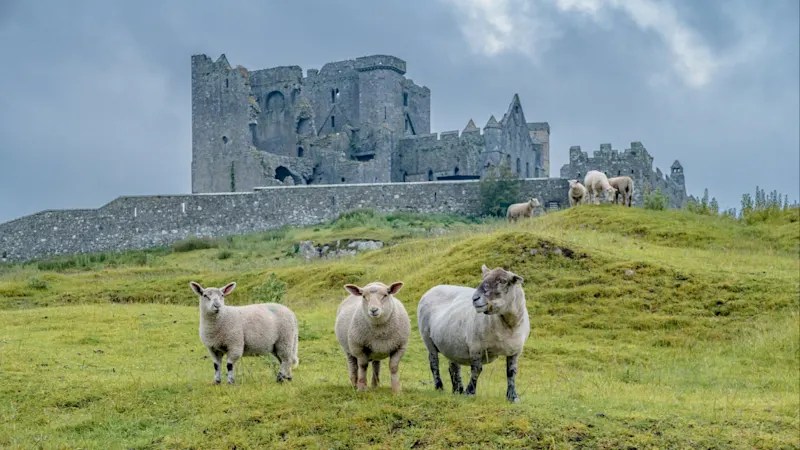
There is something about Ireland that makes even the ordinary feel touched by story. Maybe it is the weather rolling in from the Atlantic, or the stone cottages scattered across green fields, or the way history seems to sit just beneath the soil. On certain mornings, when the wind lifts a line of laundry and sends it dancing against a gray sky, it is easy to imagine that people have been watching this same quiet ritual for centuries. Shirts billow. Sheets snap. Socks twist on wooden clothespins. Laundry, in Ireland, has never simply been laundry. It has been work, survival, domestic rhythm, and—if the old stories are to be believed—something just a little bit magical.
For most of human history, washing clothes was not a quick chore tucked between errands. It was an event. In Ireland, as in much of Europe, the traditional washing day fell on Monday. This was the day when the household gathered its linens, shirts, stockings, aprons, and work clothes after a long week of use. In rural cottages, particularly throughout the eighteenth and nineteenth centuries, the process of washing was laborious and deeply physical. Large iron or copper pots were filled with water and heated over the hearth. Lye soap, made from animal fats and ash, was shaved or dissolved into the boiling water. Garments were soaked, scrubbed, wrung, and rinsed repeatedly until they were judged clean enough to face the wind.
Water itself could determine the entire rhythm of washing day. In many rural parts of Ireland, especially before modern plumbing, women carried heavy buckets from wells, rivers, or communal pumps. The River Liffey in Dublin, the River Shannon stretching through the midlands, and countless small streams and fjords throughout the countryside served as gathering places where washing boards were set along the banks. It was common to see clusters of women kneeling near the water, their hands red from the cold, beating clothes against stones while sharing news, gossip, and family stories. Washing day doubled as a social hour, the domestic equivalent of a town square.
In Dublin during the nineteenth century, the laundries of the city became a world unto themselves. Some were private businesses, others attached to convents or charitable institutions. Laundry work was considered respectable but demanding labor. Steam rose constantly from washrooms filled with boiling vats. The smell of soap and damp linen filled the air. Large wooden mangles—rollers used to squeeze water from cloth—stood like mechanical guardians over the process. Workers spent hours scrubbing, lifting, and wringing fabric until their hands became permanently roughened by the work.
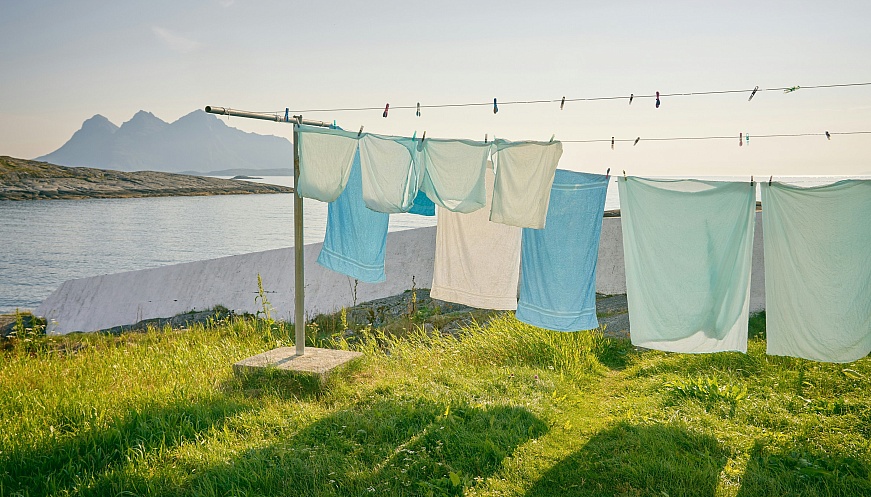
But outside the cities, the clothesline remained the final stage of the ritual. Once garments had been scrubbed and rinsed, they were carried outside to dry in the open air. Ireland’s famously unpredictable weather made this step something of a gamble. The island sits squarely in the path of Atlantic winds, which means rain can appear almost without warning. Yet that same wind could dry laundry with astonishing speed. Clotheslines were strung between cottages, along stone walls, or across garden hedges. Wool sweaters, linen shirts, aprons, and undergarments fluttered against landscapes that were as green as legend.
There is an old Irish saying that the wind off the Atlantic can clean anything. It may not be scientific, but anyone who has stood beside an Irish clothesline on a breezy afternoon understands the sentiment. The air smells of salt and grass. The wind snaps sheets into sails. Laundry dries quickly, and when it comes down from the line it carries the faint scent of the outdoors. In many rural households, people believed that outdoor drying gave fabric a kind of freshness that no indoor fire could replicate.
Of course, Ireland’s weather was not always cooperative. Long periods of rain meant that laundry sometimes had to be dried indoors near the hearth. Wooden racks were placed close to the fire, and garments hung from lines stretched across kitchen ceilings. In small cottages this could make the house feel like a forest of fabric. Stockings dangled beside aprons. Shirts hung beside blankets. The warm smoke of peat fires filled the cloth, leaving a faint earthy scent behind.
Peat itself played a quiet role in the domestic world of Irish laundry. Cut from bogs and dried into bricks, peat served as a primary fuel source in many rural regions. When burned in hearths it produced a distinctive smell—earthy, smoky, and unmistakably Irish. Clothing dried near these fires absorbed that scent, creating a kind of olfactory fingerprint of the landscape. Even today, travelers visiting rural cottages sometimes notice the faint trace of peat smoke lingering in old fabrics and linens.
But laundry in Ireland did not exist only in the realm of practical work. Like so many everyday tasks, it found its way into folklore and superstition. The Irish imagination has always been rich with stories where the ordinary world brushes up against the supernatural. Streams and crossroads, hills and forests, and even domestic chores could become the stage for something otherworldly.
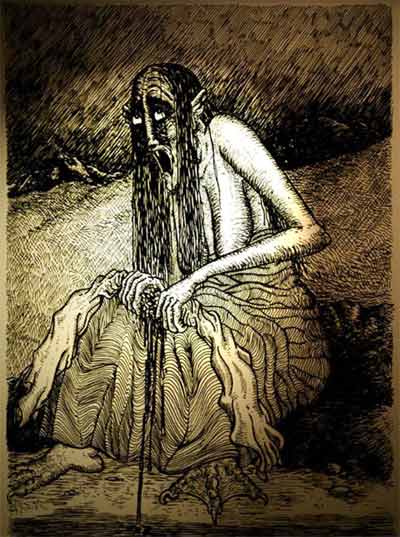
One of the most haunting figures in Irish folklore is the Bean Nighe, often translated as the Washerwoman at the Ford. According to legend, travelers wandering near rivers or remote crossings might encounter a solitary woman kneeling beside the water, washing clothes in silence. At first glance she might appear to be an ordinary laundress. Yet something about the scene always felt wrong. The garments she washed were said to be stained with blood, and the clothes belonged to someone whose death was soon approaching.
The Washerwoman did not always reveal herself openly. In some tales she appeared as a bent old woman, her hands moving tirelessly through the water. In others she looked strangely young, her face pale against the dark riverbank. Travelers who recognized her presence were said to be witnessing a supernatural omen. The clothes she washed belonged to the person whose fate had already been sealed.
Stories of the Bean Nighe likely evolved from older Celtic beliefs surrounding fate and prophecy. In Gaelic mythology, washing and water often symbolized purification or transition between worlds. Rivers marked boundaries—between villages, between territories, and in folklore, sometimes between life and death. The Washerwoman at the Ford became one of many figures in Irish storytelling who existed on that thin border between the everyday and the unknown.
Laundry also appeared in more lighthearted superstitions that circulated within households. Many Irish families believed that hanging clothes inside out invited bad luck into the home. Others insisted that laundry should never be left outside overnight on certain feast days, when wandering spirits might pass through the fields. Whether these beliefs were taken seriously or simply repeated for fun depended on the household, but they reveal how domestic work was woven into a larger cultural imagination.
Rain itself, which so frequently interrupted washing day, sometimes earned a more optimistic interpretation. Some households jokingly referred to sudden showers as a “blessing rinse.” The idea was simple: if the rain arrived after clothes had already been washed and hung, then nature itself had decided to give the laundry one final rinse cycle. It was a practical way of laughing at the weather rather than fighting it.
The arrival of spring, and with it the celebration of St. Patrick’s Day, often marked a turning point in the rhythm of laundry. Winter in Ireland could be long and damp, with fewer opportunities to dry clothing outdoors. As March approached and the days grew slightly longer, households began airing out blankets and linens that had been stored through the colder months. Windows were opened, mattresses were beaten, and clotheslines returned to active duty.
St. Patrick himself, the fifth-century missionary credited with bringing Christianity to Ireland, could hardly have imagined that his feast day would one day inspire parades, green clothing, and global celebrations. Historical accounts describe Patrick as a Romano-British Christian who was kidnapped as a teenager and brought to Ireland as a slave. After escaping and returning home, he eventually felt called to return to Ireland as a missionary. His teachings helped establish Christian communities across the island during the fifth century.

One of the most enduring symbols associated with St. Patrick is the shamrock. According to tradition, Patrick used the three-leafed plant to explain the concept of the Holy Trinity: Father, Son, and Holy Spirit. Whether the story is historically accurate or simply a later legend is difficult to confirm, but the shamrock became permanently linked with Irish identity and spirituality.
Over time the shamrock also came to symbolize renewal and growth. As winter receded and the countryside turned green again, the small plant served as a reminder that life returned each spring. It is not difficult to imagine how this symbolism could connect with the domestic ritual of washing. Just as garments were scrubbed clean after months of use, homes themselves were refreshed at the end of winter. Linens were aired. Curtains were washed. The household emerged into spring feeling renewed.
In that sense, laundry itself becomes a quiet metaphor for renewal. A shirt worn through a week of work returns to the wash tub, is scrubbed clean, and emerges ready to begin again. Sheets stained by the routines of daily life are rinsed, dried, and folded back into order. Across centuries of Irish history, this simple cycle repeated itself week after week, generation after generation.
Modern washing machines have changed the physical work involved, but the rhythm remains familiar. The hum of a washer replacing the boiling copper pot. The spin cycle replacing the wringing hands of earlier centuries. And yet the final step—the moment when clean laundry meets fresh air—still holds something of the old magic. When a line of clothes catches the wind, the scene looks remarkably similar to what it must have looked like a hundred years ago.
Stand beside a clothesline on a breezy afternoon and watch the sheets move. They billow like sails. They snap and ripple with each gust of wind. It becomes easy to imagine the countless washing days that came before, when families stood in similar yards watching their work flutter against the sky. Laundry may be ordinary, but it is also deeply human. Every civilization has its version of it. Every culture carries its own traditions, stories, and superstitions surrounding it.
Ireland, with its long memory and love of storytelling, simply happens to wrap those traditions in a little more poetry.
Perhaps that is why laundry feels so at home in Irish lore. It sits at the intersection of work and story, necessity and imagination. It appears in myths of mysterious washerwomen beside rivers. It appears in the domestic rituals of Monday wash day. It appears in the laughter of families watching rain clouds threaten their carefully hung lines.
And every year, when St. Patrick’s Day arrives and the countryside turns green again, those old rhythms quietly return. Windows open. Air moves through the house. A load of laundry finishes spinning. A basket of freshly washed clothes finds its way outside.
Somewhere between the smell of soap and the movement of the wind, the ordinary becomes something a little more meaningful. The clothesline stretches across the yard like a thread connecting past to present. Shirts sway gently beside sheets. Socks twist against the sky. And if the breeze is strong enough, the entire line begins to dance.
Whether it is luck, lore, or simply the wind coming off the Irish Sea, laundry in Ireland has always carried a bit of quiet magic. The next time your own washing machine finishes its cycle and you step outside to hang a line of clothes in the sun, imagine those same movements repeated across centuries of Irish fields and villages.

Laundry, after all, has always been more than a chore. Sometimes it is a ritual. Sometimes it is a story waiting to be told. And sometimes, if you listen closely to the wind moving through a line of clean sheets, it almost feels like the island itself is whispering back.
There is even a bit of music that feels like it belongs to the rhythm of wash day. Traditional Irish folk musicians have long played a lively jig known as The Irish Washerwoman. The tune dates back to at least the eighteenth century and has been passed down through generations of fiddlers and dancers. It is fast, cheerful, and full of the kind of energy that makes you imagine someone moving quickly between the wash tub and the clothesline while the wind snaps fabric in the background. If you happen to come across a recording of it—perhaps the very one you found—consider pressing play the next time you are sorting socks or folding towels. Listen to it while you do your laundry. The pace of the fiddle feels almost perfectly matched to the rhythm of washing, rinsing, wringing, and hanging clothes out to dry. Somewhere between the music and the movement of clean laundry in the breeze, the old Irish world of washing day feels very close again.
Final Spin
This St. Patrick’s Day, if your laundry line sways beneath a patch of green sky, take a moment to appreciate the quiet ritual of clean clothes drying in the wind—and remember that somewhere in Ireland’s long history, even laundry carried a little bit of myth stitched into its seams.

 The Laundry Club Blog
Leave a comment