Dearest Gentle Reader,
It has come to this author’s attention that while the Ton is endlessly preoccupied with courtship, scandal, and advantageous matches, there remains one matter of far greater consequence left unexamined.
The laundry.
Yes — the very garments that flutter across candlelit ballrooms, that brush gloved hands in secret gardens, that whisper promises beneath chandeliers — do not arrive immaculate by magic. Behind every empire waist and snowy glove lies steam, starch, sweat, and someone else’s labor.
And if we are honest, reputation in the Regency worked much the same way.
Let us lift the hem and look beneath.
The Regency Spin Cycle
Bridgerton is set during the Regency Era (1811–1820), when London society operated like a finely tuned machine of ritual and surveillance. Appearances were everything. A young woman’s debut was not merely an introduction — it was a public unveiling of value.
In this world, clothing was currency.
Muslin gowns, light and airy, became the fashion of the day. Inspired by classical antiquity, they suggested innocence and refinement. But muslin was also unforgiving. It wrinkled easily. It stained visibly. It required constant maintenance.
Which is to say: purity was high-maintenance.
The Ton’s social calendar functioned like a relentless spin cycle. Balls. Promenades. Musical evenings. More balls. Between each event, gowns were aired, spot-cleaned, brushed, and sometimes completely rewashed. Gloves were starched. Stockings were scrubbed. Petticoats were boiled.
The ballroom shimmered because the washroom labored.
Empire Waist, Empire Maintenance
The empire silhouette — that high waistline resting just beneath the bust — was deceptively simple. But its simplicity made every flaw visible. A drop of wine. A brush of mud from a carriage step. A bead of perspiration beneath heavy dancing.
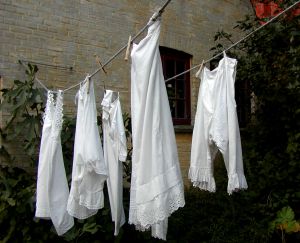
White was the color of the season. White signaled virtue, delicacy, and status. It also signaled access to labor.
Because white does not remain white without work.
Laundry in the early 19th century was brutal. Water had to be hauled and heated. Lye soap could burn skin raw. Linens were boiled in copper vats, beaten against boards, wrung by hand, and hung to dry — weather permitting. Irons were heated over open flame and swapped continuously to maintain temperature.
This was not aesthetic labor.
It was physical endurance.
And yet, when Daphne glides across the floor in luminous silk, we do not see the red hands of the maid who scrubbed her chemise at dawn.
Invisible labor preserves visible luxury.
Sound familiar?
The Class Divide in Soap and Steam
Aristocratic women did not wash their own garments. That work belonged to laundry maids, housemaids, and hired washerwomen — often working-class women whose lives were defined by other people’s stains.
This divide is essential.
In Bridgerton, we see drawing rooms and garden flirtations. We do not see the servants’ quarters thick with humidity. We do not hear the slap of wet linen against stone. But that world existed directly beneath the polished surface of the Ton.
Laundry was cyclical, repetitive, and relentless.
So was reputation management.
A single misstep at a ball could require weeks of social “airing out.” A rumor — once printed — spread like spilled ink on muslin. The higher one’s social standing, the more delicate the fabric. And delicate fabrics require constant care.
In that way, the Regency marriage market was less about romance and more about preservation.
Preservation of name.
Preservation of image.
Preservation of perceived purity.
The Scent of Scandal
Clothing in the Regency was not merely washed — it was scented.
Lavender sachets were tucked into drawers. Rosemary and dried herbs masked dampness. Perfumed waters refreshed bodices between wearings. To smell fresh was to signal refinement.
To smell otherwise was to invite speculation.
Scent was social armor.
And yet, no sachet could protect against the ink of Lady Whistledown.
Lady Whistledown
If laundry removes stains, Whistledown reveals them.
She does not scrub quietly in the background. She hangs society’s secrets in public view, allowing the entire Ton to inspect the fabric. She is the ultimate spin cycle — taking private indiscretions and airing them for mass consumption.
A debutante’s fall from grace works exactly like spilled claret on white muslin. Immediate panic. Frantic blotting. Desperate hope that it will not set.
But some stains, once set, do not lift.
Reputation in Bridgerton is as fragile as linen left too long in harsh sun. Overexposed. Brittle. Permanently altered.
Romance, Ritual, and the Illusion of Effortlessness
What makes Bridgerton so intoxicating is its illusion of effortlessness. The gowns float. The jewels sparkle. The courtships bloom like well-tended roses.
But nothing in that world is effortless.
The laundry cycle mirrors the social one:
Courtship → Presentation → Judgment → Correction → Repeat.
A young woman debuts like freshly pressed linen. She must remain unmarred through a season of scrutiny. Every interaction is observed. Every wrinkle smoothed. Every flaw concealed.
And if marriage is secured?
The cycle begins anew — now with nursery linens, dinner linens, household management. The work never truly ends. It only shifts.
In that sense, the Ton was not sustained by romance alone. It was sustained by maintenance.
Soap.
Steam.
Silence.
The Modern Parallel
It would be tempting to treat this as historical curiosity.
But let us be honest.
We still curate our presentation. We still fear stains — social, professional, digital. We still rely on invisible labor to maintain polished images. Today, it may be dry cleaning, photo filters, or brand management. In the Regency, it was copper vats and starch.
Different century. Same cycle.
The Ton spins.
So do I.
Final Spin
Bridgerton gives us ballrooms and breathless declarations, but beneath every waltz lies the quiet rhythm of water sloshing in a basin. Beneath every pristine glove lies a woman who scrubbed until her knuckles cracked.
The Regency was not simply an era of romance.
It was an era of relentless upkeep.
And perhaps that is the true lesson hidden in the folds of silk and lace: society has always depended on those willing to handle what others refuse to see.
Because in the end, the Ton was not held together by love stories alone.
It was held together by soap, steam, and the courage to face what needed washing.

 The Laundry Club Blog
Leave a comment