There’s a moment in every crime story—right after the screaming stops—when the room goes quiet and the living start lying.
Not the dramatic lying. Not the shaky alibi with the sweaty palms. I mean the small, domestic lies. The ones that wear slippers.
“I didn’t notice anything.”
“I cleaned because I’m a clean person.”
“That’s just laundry.”
And that’s when the clothes start talking.
Because fabric is a witness that doesn’t care if you’re charming. It doesn’t care if you cry. It doesn’t care if you have a respectable job, a spotless lawn, or a personality that makes jurors want to adopt you. Fabric absorbs what humans deny. It keeps receipts in the form of lint, trace fibers, micro-stains, pet hair, skin cells, blood chemistry, and the weird little confetti of your life that you shed without noticing.
In the modern legal world, clothing isn’t just clothing. It’s a mobile crime scene.
The night the shirt remembered
Let me put you inside a scene—not because I want to sensationalize it, but because this is how it happens: quietly, and then all at once.
A normal house. A normal evening. The kind with a basket of clean laundry sitting on a chair that’s never actually used for sitting. The kind where the dryer hums like white noise for adulthood.
A couple has friends over. There are jokes. There’s wine. There’s that familiar late-night feeling of “we should do this more” even though you won’t. At some point, someone takes out the trash. Someone else goes to bed early. The evening breaks apart like a cheap hanger.
And then—something goes wrong.
Not the cinematic kind of wrong with thunder and a violin screech. The real kind. The kind that makes your stomach go cold and your hands feel like they don’t belong to you anymore.
A sudden struggle. A hard impact. A breath that becomes a sound you can’t unhear.
Afterward, the person who did it stands there for a beat too long, staring at what they’ve made. Then their brain does what brains do when they’re cornered: it reaches for normal.
Normal looks like cleaning.
Normal looks like grabbing towels.
Normal looks like dragging fabric across hard surfaces, as if the floor will forgive you if you scrub hard enough.
Normal looks like the laundry room.
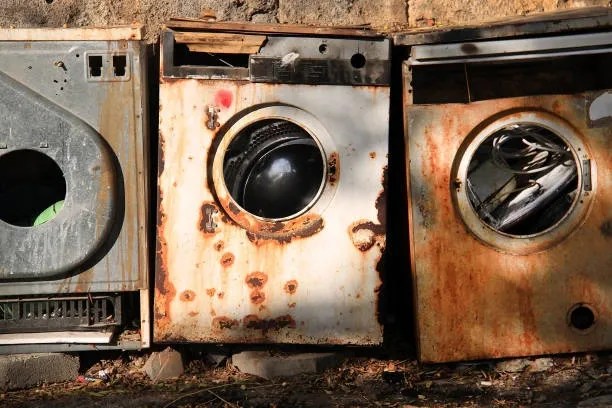
If there’s one place in the average home that feels like a reset button, it’s that little space full of detergent and denial. A washer is basically a confession booth with a lid. You throw in evidence, close the door, and let the spin cycle baptize your panic.
But here’s the part nobody tells the guilty:
Laundry doesn’t erase. Laundry moves.
And movement creates a trail.
The myth of “washed away”
True crime loves a simple fantasy: that water and detergent are moral solvents. That a little soap can turn violence back into a normal Tuesday.
In reality, washing is not a deletion key. It’s a remix.
Blood doesn’t always disappear in a wash. Sometimes it fades. Sometimes it smears. Sometimes it migrates into seams, cuffs, waistbands, and the hidden architecture of a garment. Sometimes it transfers to other items in the load. And sometimes it leaves behind faint traces that only show themselves when the lights go out and investigators bring out chemicals like luminol, which can reveal blood that someone tried to clean away. Studies have shown blood can still be detected after machine washing, and that blood can also transfer to previously blood-free items during washing—exactly the kind of detail that makes a “fresh load of laundry” look a lot less innocent.
DNA is the same kind of inconvenient. Washing can degrade DNA, sure—but it doesn’t reliably annihilate it. Researchers have examined how DNA transfers and degrades in washing machines, including “touch DNA” and blood DNA, because washing can complicate what ends up where. Meaning: even if you’re trying to erase yourself, you may be spreading yourself like a smear of invisible ink.
So the first rule of the Fabric Witness is this:
The washer is not a grave. It’s a conveyor belt.
The dryer: the overlooked confessional
If the washer is where guilt goes to spin, the dryer is where guilt goes to shed.
Every dryer is a small cyclone. It shakes loose hair, fibers, skin flakes, plant debris, construction dust, glitter from a birthday card you didn’t even like, and the tiny evidence of everywhere you’ve been. That evidence collects in the lint trap like a diary written in fuzz.
Investigators know this. Which is why, in serious cases, the laundry area can become a forensic buffet: washer drum, dryer drum, lint trap, filter housing, vents, drain lines, detergent dispensers, sink traps nearby, even the floor behind the machines where stray debris collects like secrets under a couch.
And sometimes—sometimes—the lint trap becomes the star witness.
A real case where laundry spoke louder than a person: Danielle van Dam
In 2002, 7-year-old Danielle van Dam disappeared in San Diego County. Her neighbor, David Westerfield, was prosecuted and later convicted. The case involved multiple categories of forensic evidence (hair, fibers, blood traces), but one detail is so Laundry Club it practically begs to be framed:
dog hair. in the dryer lint trap.
According to the U.S. Department of Justice’s National Institute of Justice training materials, prosecutors used canine hairs found in the suspect’s dryer lint trap to connect Westerfield to Danielle—those hairs came from the van Dam family dog.
That detail matters because pet hair is one of the most stubborn, clingy forms of trace evidence on Earth. It rides on pajamas. It embeds in blankets. It transfers to carpet. It moves like a rumor.
And it can be typed.
A Promega forensic presentation describing canine mitochondrial DNA typing notes that in the Danielle van Dam case, investigators found dog hairs not just in the motor home and on a quilt sent to the dry cleaner, but also in the lint trap of Westerfield’s dryer, and that the dog-hair haplotype matched the van Dams’ dog.
The California Supreme Court’s decision in People v. Westerfield also describes mitochondrial DNA testing of hairs collected from the defendant’s washing machine and dryer, along with other hair evidence in the residence.
Do you understand how haunting that is?
A child disappears and the machines that were supposed to make life tidy—the tidy, suburban machines—become part of the proof.
The laundry room becomes a courtroom.
The “clothing as witness” idea is not poetic. It’s forensic doctrine.
There’s a concept in forensics that shows up everywhere, even if people don’t know its name: Locard’s Exchange Principle—the idea that contact leaves traces. The more intense the contact, the richer the trace.
You touch a person, a surface, a carpet, a vehicle seat, a blanket, a stair rail, a victim’s clothing—and you take something with you while leaving something behind.
That’s why clothing matters so much: it’s constantly making contact. It brushes against furniture. It absorbs the environment. It holds onto fibers and particles like a clingy ex.
When investigators talk about “trace evidence,” it can sound small and boring—fibers, hairs, lint—like the kind of thing you’d vacuum without thinking.
But trace evidence is often the bridge between “We suspect” and “We can prove.”
Another classic: fibers and the Wayne Williams case
In the early 1980s, Wayne Williams was convicted in Georgia for murders connected to the Atlanta child murders investigation. Fiber evidence played a widely discussed role in linking victims to Williams’ environment.
The FBI Law Enforcement Bulletin published a detailed account (“Fiber Evidence and the Wayne Williams Trial”) explaining how fibers and other trace evidence were used in the Williams case.
The Georgia Bureau of Investigation’s forensic division also describes fiber examination and explicitly points to the Wayne Williams case as an example, noting that carpet fibers found on victims were linked back to carpeting in Williams’ home and traced to the manufacturer.
What’s eerie here is not just the science—it’s the intimacy.
Fibers are domestic. Carpet is ordinary. Blankets are comforting. And yet those soft, familiar materials became the backbone of something sharp enough to cut through lies in court.
What labs actually look for when they “read” clothes
Clothing can function like a timeline:
- What happened (bloodstain patterns, tears, transfers)
- Where it happened (soil, plant debris, carpet fibers, paint, industrial dust)
- Who was there (DNA, hair, touch DNA, bodily fluids)
- What was attempted afterward (washing, cleaning agents, dilution, heat effects)
And here’s the part that makes “I washed it” sound less like innocence and more like a mistake:
Investigators have tools designed specifically to find what washing tried to hide.
Luminol (and similar reagents) can reveal blood traces even after cleaning attempts, though it has limitations and can react with other substances.
Researchers have also studied how bloodstains remain detectable after machine washing and how transfer during washing can create complicated patterns across multiple textiles.
So the Fabric Witness is not just a metaphor. It’s a workflow.
The scary truth: laundry can create evidence you didn’t mean to create
Let’s talk about the most unsettling feature of washing machines in forensic science:
cross-transfer.
You wash a stained item with unstained items, and now the whole load may carry trace amounts of blood or DNA. Research on washed bloodstains and DNA transfer during washing has explored exactly this problem—blood can be transmitted during the wash, and DNA profiles are sometimes still recoverable afterward (though not consistently, and often partially).
That matters for justice, but it also matters because the public tends to believe the wash is a moral reset.
It’s not.
It’s a redistribution system.
A cautionary sidebar: not all forensic “certainty” deserves your trust
I have to say this—because if we’re doing a deep dive, we don’t get to cherry-pick the parts that make a satisfying ending.
Forensic science is powerful, but it has also been misused, overstated, and, in some disciplines, criticized for lack of reliability when applied badly (or testified to with too much swagger). Investigative reporting has documented wrongful convictions and controversies involving certain forensic methods, including bloodstain pattern analysis in some cases.
This doesn’t mean “forensics is fake.” It means the Fabric Witness should be treated like any witness: with careful interpretation, proper validation, and humility in court.
The best forensic work doesn’t shout, “GOTCHA.”
It says, “Here is what the evidence supports—and what it does not.”
That’s how you protect both justice and truth.
So how does clothing “testify” in court?
Clothing doesn’t take the stand. People do.
A forensic analyst describes what was found, how it was collected, how it was tested, and what the results mean—often with the critical caveat of probability and limitation.
In a strong case, clothing evidence doesn’t act alone. It corroborates:
- a timeline (phone records, surveillance, witness statements)
- opportunity (access to the victim, shared space, travel)
- physical realities (injury patterns, transfer possibilities)
- and yes, behavior (cleaning, disposal, unusual laundry activity)
And sometimes, when a suspect’s story is “I don’t know that person,” clothing says, quietly and brutally:
Your environment touched theirs.
Why this is horrifying in the most domestic way possible
Because laundry is supposed to be the part of life where we control chaos.
We wash away sickness. We wash away sweat. We wash away the day.
We teach kids that clean clothes mean you’re safe, cared for, normal. Laundry is a cultural signal of “everything is fine.”
So when clothing becomes evidence, it flips the entire meaning of “clean.”
It turns “freshly laundered” into a question instead of a comfort.
And it makes the laundry room—this tiny space we treat like a utility closet—feel like the most honest room in the house.
Because in the laundry room, there are no speeches. There’s just residue.
Final Spin
We spend our lives treating clothing like background noise—something we wear, stain, wash, repeat. But fabric is not passive. It remembers touch. It collects fragments. It carries the story from room to room long after the people involved decide to rewrite the ending. When humans lie, the shirt doesn’t. When a crime tries to disappear into soap and warm air, the lint trap keeps the receipts.
Support my work here : because somebody has to keep sniffing the “fresh” lies until they start smelling like truth.

 The Laundry Club Blog
Leave a comment