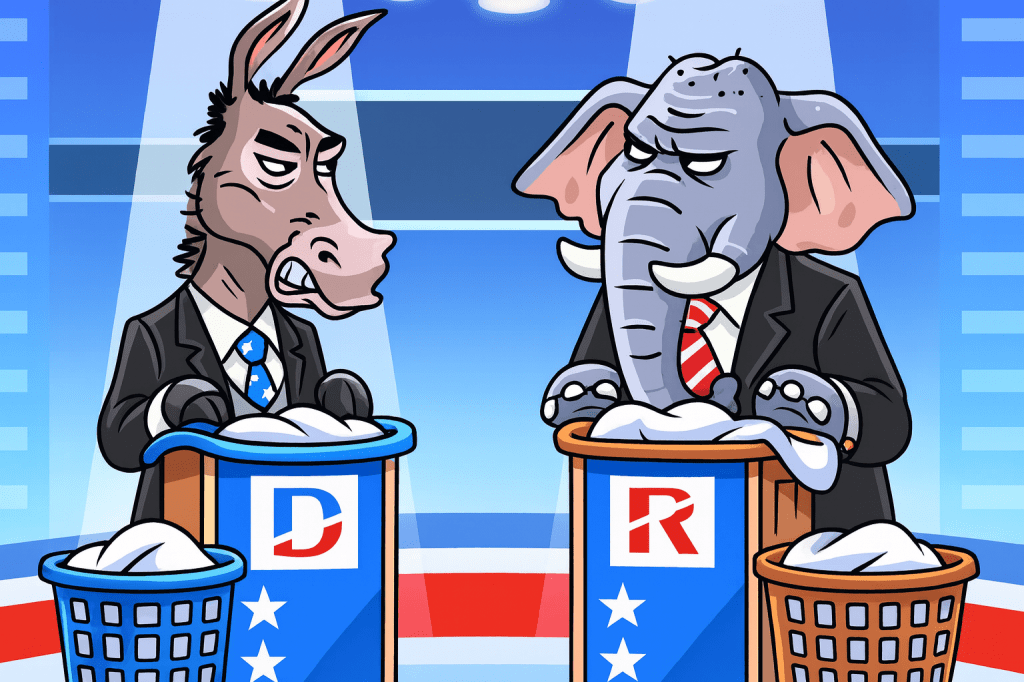
For most people, the “economy” shows up in the smallest, most ordinary parts of daily life: the grocery receipt, the light bill, the price of a gallon of milk, the cost of a jug of detergent, and the quarters fed into a laundromat machine. Laundry is one of the most universal expenses in America. No matter who you vote for or where you live, everyone has dirty socks. When politics change the cost of living, you can see it directly in what it costs to keep those socks clean. With the Trump administration again in place and tariffs returning to national conversation, many are asking a practical question: over the past 20 years of Democratic and Republican leadership, who has been better for laundry budgets? And more directly, if you want to keep your underwear clean at a reasonable price, should you be voting red or blue?
To answer this fairly, we need to understand what “laundry costs” actually include. They are not just hardware prices but a combination of washers, dryers, detergent, fabric softeners, laundry services, and even the purchasing power of the quarter itself. These costs respond differently to economic decisions. Tariffs and trade wars show up most directly in the price of machines and chemical products. Inflation and wage policy hit laundromat vend prices. Energy and water regulations influence the overhead for both homeowners and business owners. There is no single “laundry index,” but the trends over two decades reveal which administrations raised prices, stabilized them, or unintentionally caused ripple effects.
Looking back over the past 20 years, the Bush and Obama administrations operated during a period of broad support for globalized trade. Both Republican and Democratic leadership in those years allowed U.S. appliance manufacturers to take advantage of global supply chains. Korean and European brands competed aggressively, and American companies sourced parts inexpensively from abroad. As a result, washer and dryer prices increased slowly compared with many other consumer goods. Detergent and household chemical companies also benefited from predictable global supply chains, keeping prices relatively stable through the mid-2000s and early 2010s. Laundromat owners raised prices gradually, driven mostly by utilities, rent, and maintenance—not because of sudden shocks to equipment or chemical costs. In other words, throughout the Bush and Obama years, laundry expenses rose quietly but consistently in line with general inflation rather than political decisions about trade.
The turning point came during Donald Trump’s first term. In 2018, the administration imposed safeguard tariffs on imported washing machines, with rates reaching up to 50 percent on many models. Though dryers were not tariffed, economists quickly found that manufacturers raised dryer prices as well. Studies estimate that washer prices jumped by about 12 percent and dryers by a similar margin, adding roughly $86 to the cost of a washer and $92 to the cost of a dryer. Consumers absorbed most of these increases. For homeowners, this meant buying a new laundry set became more expensive; for laundromat owners purchasing multiple machines, the financial impact was far more substantial. Beyond the appliance-specific tariffs, broader trade conflicts with China increased the cost of imported components—motors, electronics, steel—and also affected detergent manufacturers, who faced higher prices for certain chemicals and packaging materials. The pre-COVID economy was strong, but within the laundry sector specifically, the Trump-era tariffs clearly raised costs.
When President Joe Biden took office, he inherited both the lingering effects of COVID-19 supply chain disruptions and many of Trump’s tariff policies, which he chose to maintain for strategic and political reasons. During 2021 and 2022, inflation surged across nearly every category of consumer goods, and laundry products were no exception. Detergents, softeners, and cleaning products rose in price due to increases in raw materials, shipping, and energy. Laundromat prices climbed as business owners faced higher utility costs and wage pressures. However, the picture shifted in 2023 when the 2018 washing machine tariffs finally expired. Researchers observed that washer and dryer prices fell sharply, dropping by around 13 percent compared to a modest 3 percent decline in other household appliances. Removing the tariffs had a measurable and immediate effect, bringing laundry equipment closer to its pre-tariff pricing trajectory.
The final and surprisingly political variable is the quarter itself—the backbone of laundromat economics. Over the past 20 years, inflation has steadily eroded the purchasing power of a 25-cent coin. A wash cycle that cost $1.50 in the early 2000s now often costs $3.00 to $4.00, not because laundromat owners are greedy, but because utilities, equipment, detergent, and rent became more expensive across all administrations. However, tariffs that increased the cost of commercial washers amplified the need for laundromats to raise prices more quickly during the late 2010s to recover their investment costs. When equipment prices eased after 2023, vend prices stabilized somewhat, though the quarter never regained its lost value.
So where does all this leave laundry voters today? Historically, periods of bipartisan support for global trade tended to keep appliance and detergent prices stable. The Trump tariffs, both in his first administration and the renewed emphasis on similar trade policies today, have historically raised the cost of washers, dryers, and sometimes laundry chemicals due to more expensive imported components. Periods with fewer tariffs—regardless of whether the White House was red or blue—tended to favor laundry affordability. That means that for the narrow purpose of keeping laundry costs down, tariff-heavy Republican policy has historically been more expensive for consumers than Democratic administrations that lean toward trade stability.
In short, if your primary political concern is the price of keeping your laundry clean, history suggests that voting blue has generally resulted in gentler costs for wash cycles, appliance purchases, and the weekly bottle of detergent.
Sources
Bureau of Labor Statistics, Consumer Price Index (appliances, laundry equipment, detergent, household cleaning products).
U.S. International Trade Commission reports on 2018 washing machine tariffs.
Recent tariff and trade policy analyses from economic research institutions, including studies on price pass-through for washer tariffs and the expiration effects on appliance pricing.
Industry surveys on laundromat vend prices and utility cost trends.
Final Spin
In politics, people argue endlessly about borders, budgets, and big ideas—but laundry has a way of telling the truth. When tariffs hit, machines get pricier. When global trade stabilizes, detergent stops climbing. When the quarter loses its buying power, families feel it at the laundromat before they feel it at the stock market. If you want to understand who’s really helping American households, don’t look at a campaign ad. Look at the spin cycle. It never lies.

 The Laundry Club Blog
Leave a comment