“Before the sleigh bells ring, the washers sing. Discover the unseen work that keeps Christmas spotless — one load at a time.”
Where detergent meets Christmas magic — and someone finally washes Santa’s drawers.
Ever wonder who scrubs Santa’s suit? Take a trip inside the Polar Wash House in The Laundry Club’s witty holiday feature — a behind-the-suds look at the elves who keep Christmas clean. Because there’s no magic dust for laundry — just good old-fashioned hard work.
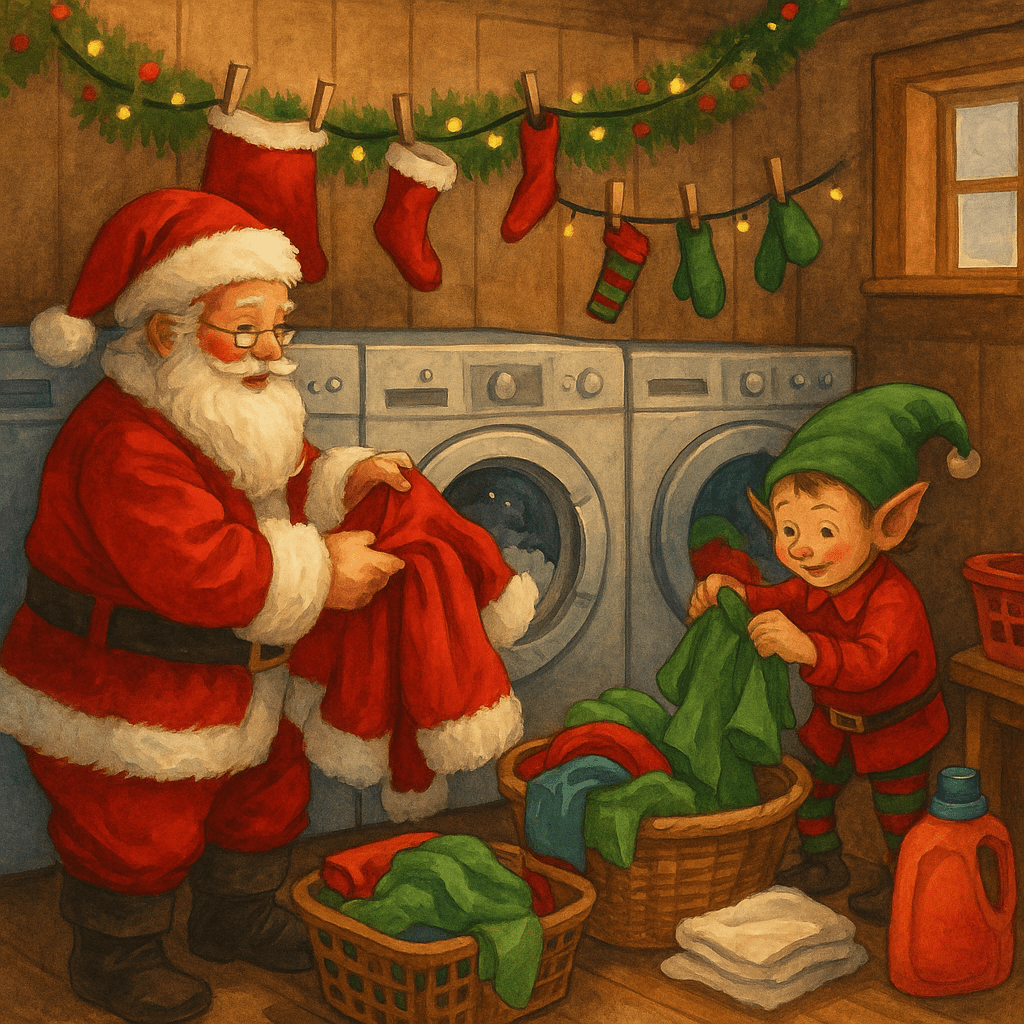
Laundry at the North Pole: The 12 Loads of Christmas
The First Load of Christmas
It begins on December 1st.
While the rest of the world unwraps chocolate calendars and dusts off last year’s ornaments, the North Pole hums to life with the most underappreciated sound of the season: the rhythmic whoosh-thump of washing machines.
There’s no magic dust for laundry. No spell, no wand wave, no enchanted bubble. Santa’s world may run on Christmas spirit, but even magic can’t remove chimney soot, cookie crumbs, and the mysterious reindeer residue that finds its way onto red velvet.
When the clock strikes midnight, the elves throw open the great doors of the Polar Wash House. A blast of peppermint-scented steam floods out. Inside, hundreds of elves in matching aprons roll up their sleeves and get to work.
Some elves make toys.
Some elves wrap presents.
And some elves — the quiet, unsung ones — wash Santa’s drawers.
They are the Washer Elves, custodians of Claus couture, guardians of garment glory, and keepers of the most sacred machine: the industrial-sized Whirlpool of Wonder.
It all starts here. The Christmas countdown begins with the first load.
The Second Load: Santa’s Suit
Santa’s famous red outfit is a marvel of holiday engineering — part velvet, part wool, all charisma. But it’s also a laundry nightmare.
Eleven months of storage leaves it stiff and stale. The fur trim yellows slightly in the Arctic dark. And after 364 days of sugar-cookie-induced hibernation, the man himself insists on a “test fitting” that usually results in several popped buttons and one embarrassed Mrs. Claus clutching a measuring tape.
On the second day of Christmas, the elves gather around the Great Copper Tub, a relic older than Santa himself. They fill it with melted snow, dash in Mrs. Claus’s secret soap (a blend of peppermint oil, reindeer milk, and sheer determination), and lower the red suit in with ceremony.
They scrub. They rinse. They wring.
They pray the dye doesn’t run.
One elder elf, named Rinseford, claims the suit’s vibrancy comes from centuries of spilled joy — or possibly cranberry sauce. Either way, it glows like a stoplight in a blizzard when the work is done.
The Claus suit gets line-dried in the Polar Breeze, where temperatures reach -40°F — a chill so sharp it freezes out every wrinkle. The elves call it Arctic Ironing.
The Third Load: Mrs. Claus’s Aprons
Behind every jolly man is a woman who keeps the stains off the legend.
Mrs. Claus’s laundry pile is deceptively small but surprisingly dangerous. Her aprons are splattered with fudge, cocoa, and candy-cane syrup so sticky it once glued two elves together for an entire afternoon. The polar kitchen runs twenty hours a day this time of year, and no fabric on Earth can withstand that much sugar shrapnel.
Her secret? Vinegar, elbow grease, and absolutely no nonsense.
“Magic’s for miracles,” she says. “Laundry’s for mortals.”
Mrs. Claus oversees her washing personally, standing beside the elves, sleeves rolled, humming carols slightly off-key. She claims the rhythm of the spin cycle helps her think. Sometimes, she tosses in a load of reindeer saddle blankets or Santa’s spare mittens, “just to feel useful.”
No one argues with her. Not even Santa. Especially not Santa.
The Fourth Load: The Workshop Uniforms
You’ve never seen chaos until you’ve seen 10,000 elves trying to do laundry before dawn.
Toy paint, glue, glitter, and gumdrops — all occupational hazards of the workshop life — cling to their green-and-red uniforms like badges of honor. But glitter, as any professional cleaner knows, is eternal. Once it’s in the wash, it’s in everything.
The elves’ solution? Industrial filters, peppermint bleach, and a strict rule: “No tinsel in the tumble.”
Their uniforms hang in long, shimmering rows, drying over lines of candy-cane twine. It looks like a Christmas army preparing for battle. Which, in a way, it is.
Every December, they march back into the workshop armed with clean smocks and fresh optimism — ready to face toy grease, frosting explosions, and the occasional gingerbread riot.
The motto above their laundry door reads:
“Clean clothes, clear conscience, full sleigh — can’t lose.”
The Fifth Load: The Reindeer Gear
You think Santa’s job is hard? Try washing a reindeer’s harness.
Between the sleigh oil, sky frost, and 40,000 miles of high-speed flight, the leather and velvet gear takes a beating. By the first week of December, Blitzen’s collar smells like wet pine and regret.
Reindeer laundry is a full-body workout. The elves haul the harnesses to the Ice Fountain, where enchanted snowmelt (with a perfect pH of 7.0, according to a very proud elf chemist) helps loosen the grime. They scrub each brass bell until it shines bright enough to blind a caroler.
Rudolph’s harness is washed separately. For safety. His nose sometimes emits electrical bursts that once fried an entire rinse cycle.
The elves still talk about “The Great Static Shock of 2017.”
The Sixth Load: The Bedding of Belief
Santa doesn’t sleep much in December, but when he does, he wants his sheets crisp.
The Claus bedroom is said to smell like nutmeg, pine, and freshly laundered dreams. The bedding is flannel spun from arctic hare fur and mistletoe fiber, washed weekly in melted aurora snow.
Mrs. Claus insists on hanging them outside overnight, where the northern lights infuse the fabric with “holiday cheer.” The elves swear the sheets glow faintly in the dark, though Santa claims it’s just static.
Either way, on the morning of the 24th, he wakes rested, recharged, and lint-free — a man ready to deliver joy across the planet in one night.
All thanks to thread-count discipline.
The Seventh Load: Naughty & Nice Lists
Most people don’t realize paper is technically a textile. And when you’re making lists that span the entire population, ink stains happen.
The elves in Records & Behavior Management (a department nobody visits voluntarily) spend the seventh day soaking parchment scrolls in gentle cleaning solutions, blotting out smudges and re-inking names that blurred during storage.
Every “nice” child’s name gets a gold-star watermark. Every “naughty” one gets a faint peppermint aroma — partly to mask the scent of regret.
Some elves joke that the ink never fully washes out. That’s why Santa double-checks it twice.
The Eighth Load: The Toy Towels
Toymaking is messy work. Between the paint, varnish, oil, and plush stuffing, the elves go through more towels than wrapping paper.
By mid-December, the workshop’s towel bins overflow like snowdrifts. That’s when the Laundry Division kicks into overdrive. Massive dryers roar like jet engines, fluffing cotton clouds that billow into the rafters.
The air smells of cinnamon and bleach. Static sparks fly with every fold. The elves hum in rhythm, singing their adapted version of “Deck the Halls”:
Fold the towels and stack them steady,
Fa-la-la, the sleigh’s not ready!
Scrub the stains and bleach the glitter,
Fa-la-la, the elves grow bitter.
They laugh, they sweat, they spin — and by midnight, every towel is warm, soft, and ready to meet a toy’s tiny fingerprints.
The Ninth Load: The Wrapping Cloths
In the old days, the North Pole didn’t use paper. They wrapped gifts in reusable cloth — sustainable, soft, and delightfully scented.
Those cloths are still in rotation, centuries old and laundered thousands of times. Each one bears the faint aroma of holidays past — a mixture of cinnamon, cocoa, and memory.
On the ninth day, the elves unfurl bolts of these legendary fabrics: snowflake muslin, holly silk, peppermint plaid. They inspect, wash, press, and fold them in perfect stacks.
Santa’s head wrapper, Tinsel Mae, says the trick to spotless cloth is snow-vapor pressing: “We iron with clouds.”
It’s sustainable magic at its finest — no glitter required.
The Tenth Load: Laundry for the Lost
Not every Christmas story is tidy.
Every year, the elves receive unclaimed garments in the mail — mittens that fell from sleighs, scarves left at playgrounds, socks separated by circumstance. The Polar Post Office forwards them all to the Lost Laundry Division, where elves wash, mend, and quietly redistribute them.
A mitten here, a coat there, a small sweater for a cold child somewhere in the world.
No one talks much about this department. It doesn’t sparkle like toy-making or sleigh-tuning. But it’s where the spirit of Christmas breathes deepest — in the quiet act of laundering the forgotten and sending warmth where it’s needed most.
The Eleventh Load: The Emergency Backup Suit
Every professional has a contingency plan.
Santa’s backup suit — affectionately called The B-Team Blazer — is kept sealed in a cedar chest. It’s a touch looser, a little faded, but perfectly functional.
It comes out for cleaning only once a year, on December 23rd. The elves treat it like an artifact, gently brushing the velvet, steaming the cuffs, polishing the brass buttons until they gleam like morning stars.
There’s a myth that if anything happens to the main suit — a chimney mishap, an unexpected downpour, or a poorly timed milk explosion — this one will shimmer to life automatically.
But the truth is simpler: Mrs. Claus just doesn’t take chances.
The Twelfth Load: The Eve of Flight
By the twelfth day of Christmas — December 24th — the entire North Pole smells like detergent, pine, and adrenaline.
The Polar Wash House buzzes from dawn till dusk.
Elves fold with lightning speed.
The dryers hum in harmony with sleigh bells.
Reindeer gear gleams. Toy towels sparkle. Santa’s suit hangs pressed and pristine, the fur trim bright as the moon. Even the sleigh blanket smells like peppermint and ozone.
Mrs. Claus makes one final inspection, her eyes soft but sharp. “Good work, everyone,” she says. “The world won’t know what hit it.”
At precisely 10 p.m., Santa steps into the freshly washed suit. The elves cheer. Someone pops a cork. And for a fleeting moment, the laundry crew — the most invisible of Christmas workers — feel like the heart of it all.
Because without them, there would be no sparkle in the suit, no twinkle in the trim, no comfort in the Claus.
Magic may make the sleigh fly, but clean laundry makes it worth flying in.
Epilogue: After the Spin
When Christmas morning dawns across the world, the elves finally rest. They sip cocoa, hum lullabies, and watch the dryers slow to silence.
Steam curls upward like incense. A hush falls over the Polar Wash House.
One elf, still dusted in starch, looks up at the ceiling where mistletoe hangs and whispers, “Same time next year?”
Mrs. Claus smiles, tugs her apron tight, and tosses another load into the wash.
Because even in a land of miracles, somebody has to do the laundry.
Final Spin
The next time you fold your Christmas pajamas or scrub eggnog out of a tablecloth, think of the elves up north — wrists deep in soap, eyes bright with purpose. They remind us that even the biggest magic begins with small, steady work.
Santa might carry the spirit of Christmas around the world, but it’s the laundry crew that keeps the fabric of it clean.
Support The Laundry Club Blog — because even at the North Pole, the spin cycle never ends.

Merry Christmas from The Laundry Club

 The Laundry Club Blog
Leave a comment