A Special Halloween Feature by The Laundry Club Blog
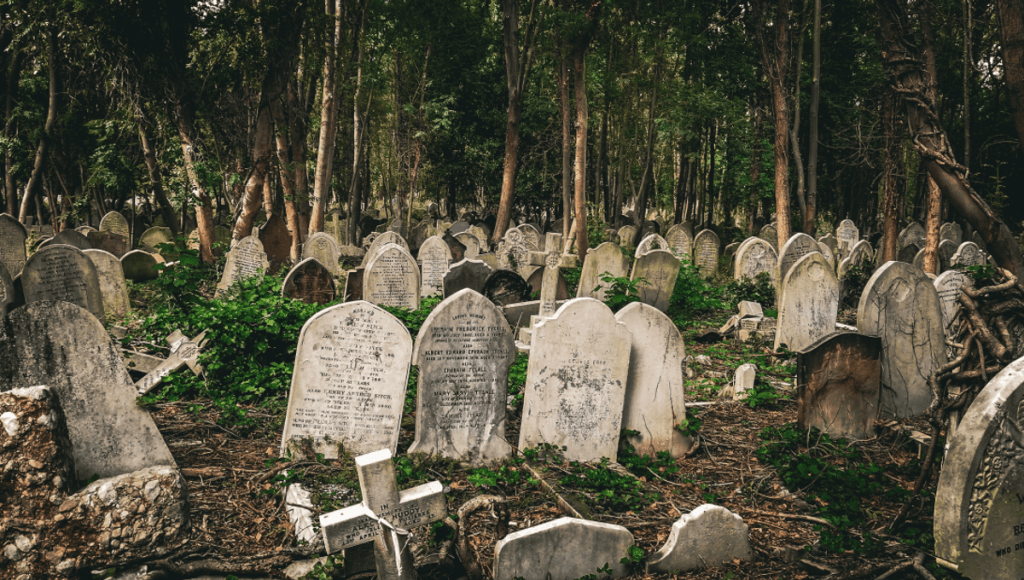
Somewhere beyond the thrift store bins and donation drives, past the charity warehouses and recycling depots, there’s a place where the clothes go to die.
They arrive by container ship and cargo plane, bundled in plastic like mummies — the rejected, the ruined, the unwashed. Torn jeans, mildewed bedsheets, blood-stained uniforms, sequined dresses that never made it past one good night. Every fiber tells a story someone tried to forget. Every fabric carries the scent of a life once lived — smoke, sweat, perfume, sorrow.
Welcome to the textile graveyard.
I. The Ghosts of Fabric Past
Before laundry became a convenience, it was a covenant. In ancient riverbeds, women beat linen on stones, praying the stains would release before the light faded. During the Industrial Revolution, laundresses boiled cotton in iron cauldrons, their hands raw and pink from lye soap. Cleanliness was salvation. Laundry meant life continuing — a ritual of renewal.
But in the modern world, laundry is cheap, constant, and disposable. The average American discards nearly 80 pounds of textiles each year. Worldwide, that’s tens of billions of garments — fast fashion, polyester blends, “micro-trend” hoodies that never see a second season. They don’t decompose; they just lie there, waiting out the centuries.
In Ghana, the Kantamanto Market has become a global funnel for our unwanted wardrobes. Bales of “donations” from the West spill open into heaps taller than people. Some are resold, others shredded, but many are too filthy, too torn, or too synthetic to salvage. The leftovers wash into the sea, tangling with fishing nets, forming islands of damp, colorless ghosts.
In Chile’s Atacama Desert, where the dunes never sleep, discarded clothing piles up like an unburied army — 100,000 tons of it. The sand swallows it by day and exhales it by night, revealing sleeves that flutter like phantom flags. Even satellites can see it from orbit.
You could call it waste. Or you could call it haunting.
These are the clothes that refused to die quietly.
II. When Laundry Fails the Living
There’s a darker class of textile — the ones that can’t be cleaned at all.
Hospitals and nursing homes generate mountains of linens that must be sterilized or destroyed. Firefighters’ gear absorbs toxic smoke and melted plastics. Crime scenes yield shirts too stained for soap, sheets too incriminated for bleach.
Some fabrics are contaminated beyond recovery — chemical spills, mold infestations, body fluids, industrial residues. These can’t be donated, washed, or recycled. They’re burned, buried, or chemically shredded until nothing remains but ash and dust. The laundry of catastrophe has its own rituals, its own quiet taboos.
After natural disasters, humanitarian groups often find themselves with tons of “unsuitable donations” — winter coats sent to tropics, or mildew-infested clothes unfit for human wear. They become logistical ghosts, trapped between goodwill and reality, eventually dumped in the same textile graveyards that haunt the deserts and deltas.
There’s something tragic about a shirt that couldn’t be saved. Something funereal about a uniform that survived the fire but not the wash. In a world obsessed with cleansing, these fabrics are exiled — uncleanable, unredeemable, unspinnable.
Even in the laundry world, there are sins beyond bleach.
III. The Industry of Erasure
Few talk about what happens next. There’s an entire shadow industry devoted to textile destruction — companies whose job is not to launder, but to obliterate.
They collect the unsalvageable from hospitals, airlines, correctional facilities, and fashion houses. These fabrics are shredded into fibrous confetti, compressed into insulation, or incinerated in furnaces hot enough to vaporize memory.
Sometimes luxury brands destroy unsold merchandise to protect exclusivity — handbags, jackets, scarves burned to ash rather than discounted. The smoke rises over factory skylines, curling like incense for the ghosts of unsold dreams.
The irony isn’t lost on those who still fold towels for a living. For centuries, laundry has stood as humanity’s attempt to restore order — to wash away the evidence of chaos. But this new ritual of destruction does the opposite. It conceals, denies, and buries.
It’s the anti-laundry — not purification, but erasure.
IV. Voices in the Fabric
If you listen closely — really listen — you can hear the whispers in the fibers.
In the textile graveyards, fabric doesn’t rest. Polyester crinkles under the desert wind. Denim sighs when the temperature drops. The synthetic blends hum faintly, resonating with static electricity, as if the clothes remember the bodies that once moved inside them.
A dress that once danced.
A uniform that once saluted.
A baby blanket that once comforted.
They murmur to one another beneath the layers of dust and time, sharing the gossip of forgotten laundries:
“She tried bleach first.”
“He never meant to spill it.”
“We were supposed to dry by morning.”
The sound is faint — like a washing machine cycling far away in another lifetime.
V. Haunted Laundries & Cursed Cloth
If you think the textile graveyard is all metaphor, you haven’t walked through an abandoned dry cleaner.
In cities all over the world, there are shuttered laundries frozen mid-spin: rusted washers still half-full of water, racks of unclaimed garments dangling like bodies. Some have been closed for decades, yet the smell of starch and soap lingers like a memory that refuses to rinse out.
Paranormal investigators have long noted that laundromats and old washing spaces often carry residual energy — perhaps because clothing absorbs emotion so well. A shirt remembers the heartbeat beneath it. A pillowcase remembers tears. A wedding dress remembers both vows and betrayal.
And when these objects are abandoned, they don’t just decompose — they wait.
In folklore, there are the washerwomen of doom — spirits who scrub bloodied linen by moonlight to warn of approaching death. In Celtic legend, they’re called the Bean Nighe. In Slavic myth, they’re the rusalki, drowned souls forever washing their own burial garments.
Even the ghosts, it seems, cannot escape laundry day.
VI. Resurrection: The Second Spin
Not all is lost in the graveyard. Some fabrics rise again.
Textile recycling facilities are the modern resurrection chambers. Shredded cotton becomes paper pulp; polyester turns into insulation; wool is reborn as felt. Companies are experimenting with enzyme-based recycling that breaks fibers down to their molecular roots and rebuilds them as new cloth.
The Japanese have developed “closed loop” uniforms for train attendants — the same fabric worn, washed, recycled, and rewoven into the next generation’s uniforms. It’s laundry reincarnated: each wash cycle another turn of the karmic wheel.
Some designers now work exclusively with “deadstock” — fabrics discarded by major brands, resurrecting fashion’s ghosts into one-of-a-kind couture. Others craft haunting art installations from textile waste, draping galleries in the remnants of forgotten wardrobes.
In the end, every shirt wants another chance at life. Every stain wants forgiveness. Every fiber, no matter how frayed, wants to be touched again.
VII. The Emotional Weight of the Unwashed
We form attachments to our clothes the way sailors trust their ropes. Each piece holds something of us — the day we wore it, the body that filled it, the person who saw us in it.
To throw clothing away feels almost like betrayal. That’s why donation bins are so comforting: they let us pretend that what we’ve cast off will find another life. But the truth is, much of it won’t.
Behind every bin sits a long chain of sorting, grading, shipping, and rejection. The best items get sold. The rest drift toward the graveyards, where no one separates the polyester from the prayer.
There’s a peculiar grief in realizing that most of what we wear will outlive us — that the shirt you bought for a concert could still exist, intact, a hundred years from now, buried under layers of sun-bleached polyester ghosts.
Laundry is supposed to make things new again. But what do we do when the cycle ends?
VIII. The Last Rinse
If the textile graveyard has a sound, it’s not silence. It’s the low, endless hush of fabric rubbing against itself — a thousand sleeves, a million collars, brushing like dry leaves in the wind.
And if it has a smell, it’s the strange blend of detergent and decay — clean trying to fight its way through the rot.
Walk among these heaps long enough and you’ll start to feel something familiar: a tug of recognition. The curve of a hem you once owned. The print of a shirt you swear you saw in a thrift store years ago.
You realize, with a kind of quiet horror, that we’ve built a world where laundry no longer redeems — it just defers decay. Our machines are too efficient, our closets too full, our fabrics too immortal. We wash and wash, yet nothing ever really comes clean.
The clothes are waiting. The graveyard grows. The planet, like an overworked dryer, hums in exhaustion.
And still, somewhere, a washing machine spins.
Final Spin
In the end, even our clothes tell ghost stories. They outlive our bodies, absorb our lives, and whisper our secrets long after we’ve stopped wearing them. They are the closest thing most of us will ever have to relics — not of saints, but of ordinary sinners trying to stay presentable in a messy world.
So when you wash that shirt this week, think of the ones that never got their final rinse. The ones that tore before they were forgiven. The ones now buried under foreign suns, dreaming of soft water and second chances.
Because nothing really disappears in laundry — it just waits to be remembered.
Support The Laundry Club Blog — because even the forgotten deserve a final spin.

Happy Halloween!

 The Laundry Club Blog
Leave a comment