In the shadows of World War II, where battles raged not just on the front lines but in back alleys, bunkers, and barracks, the humble laundry took on a role far darker than anyone could have imagined. Amid the countless covert operations carried out by Allied forces, one of the most chilling involved the deliberate poisoning of enemy uniforms—weaponizing the very clothing worn by Axis soldiers.
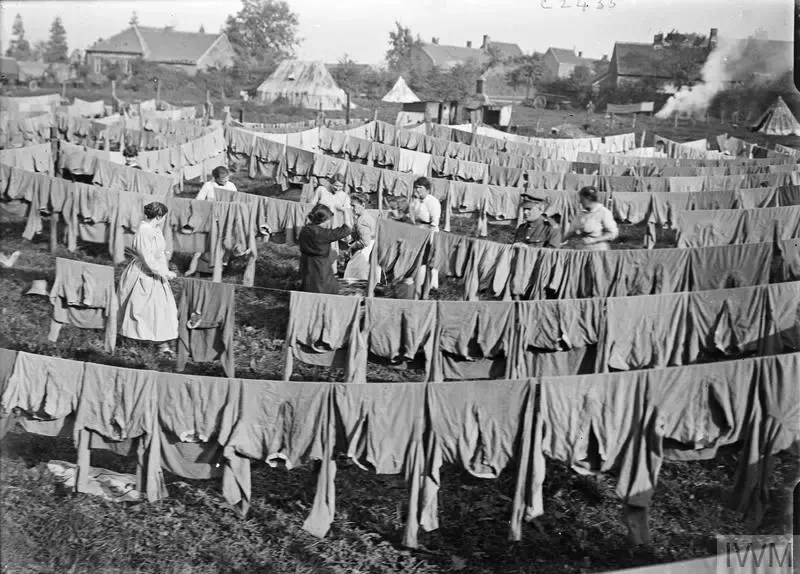
Dirty Tricks in a Clean Disguise
In 1944, British intelligence agencies, particularly the Special Operations Executive (SOE)—an elite and secretive unit created by Winston Churchill to “set Europe ablaze”—began documenting strange deaths among German officers. In some cases, the cause was mysterious skin lesions. In others, respiratory failure or rapid organ deterioration followed the wearing of freshly laundered clothing. When the source was traced, it was not the battlefield, but the uniform itself.
SOE reports reveal a disturbing counter-sabotage campaign: poisoned clothing.
While not officially acknowledged until decades later, declassified British and American archives contain clues about a network of resistance operatives and Allied agents tasked with infiltrating German-controlled laundries and uniform depots. These sites—often located near military command posts—became soft targets for unconventional sabotage.
The Chemicals of Covert Warfare
The poisons varied. Some uniforms were dusted with arsenic trioxide, a potent toxin that caused skin ulcers and internal bleeding upon prolonged contact. Others were laced with organic irritants such as thallium or cantharidin, a blistering agent derived from the infamous Spanish fly. These substances absorbed through the skin or were activated by body heat and sweat—making them the perfect stealth weapon.
One SOE field report from France described how a laundress working for a German officer was recruited by the French Resistance. She was supplied with a fine powder that, when rubbed into the seams of collars and cuffs, would gradually poison the wearer. The officer reportedly died three weeks later from what was assumed to be a bacterial infection.
Women of Resistance: Laundresses in the Shadows
Throughout occupied Europe, laundresses and washerwomen played a critical—yet often overlooked—role in resisting Nazi control. Many of these women were neither soldiers nor spies by profession, but they wielded incredible influence from their vantage point inside German households, military installations, and laundry depots.
These women had unprecedented access to the personal belongings of Nazi officers. In cities like Paris, Warsaw, and Prague, German officials frequently hired local women to clean and press their uniforms. In rural areas, garrisons and outposts relied on village laundresses for their daily hygiene needs. What the Germans didn’t realize was that the very people they depended upon for cleanliness could also become the agents of their demise.
In Poland, the Armia Krajowa (Home Army) documented numerous instances where laundresses acted as information couriers or planted coded messages in shirt cuffs. Some used washing lines to signal safe passage to partisans hiding in the woods—hanging white sheets to indicate safety or red cloth to warn of danger.
Others took a more aggressive route.
In 1943, a Czech laundress named Milada Tomášová was arrested by the Gestapo after it was discovered she had been applying a toxic irritant to the inner linings of SS officers’ trousers. She had been recruited by a local resistance cell and trained by a former pharmacist in how to dilute and handle chemical agents. Her arrest followed the mysterious death of a regional commander in Brno. Milada was interrogated for weeks before being executed. Her story lives on in Czech resistance lore as a symbol of defiant patriotism.
Another documented case involved a Dutch woman named Johanna van der Meer, who worked as a cleaner and laundress at a German military barracks near The Hague. Under the direction of British SOE contacts, Johanna kept detailed records of troop movements, which she gleaned from laundry tags and labels. She used starch powder mixed with sulfur compounds to lace the necklines of several officers’ uniforms. At least two deaths were connected to her activities. She was eventually captured during a sweep of suspected collaborators, but her final fate remains unknown.
A Deadly Profession
While these stories illustrate heroism, they also underscore the extreme danger faced by women involved in these acts. Laundresses operated under constant surveillance and suspicion. Many were arrested, tortured, or killed without trial. Their resistance efforts were rarely acknowledged publicly, either due to postwar gender biases or the secretive nature of their missions.
Yet despite the risks, their actions sowed chaos within the Nazi ranks. The psychological toll on officers, who feared even the most intimate aspects of daily life, cannot be overstated. Clean uniforms—a symbol of order and control—had become agents of subversion.
Internal German documents, including reports from the Sicherheitsdienst (SS intelligence), reveal growing paranoia among officers. Some began sending their uniforms back to the Reich for cleaning. Others insisted on personally washing their own garments. Orders were issued to thoroughly inspect laundry deliveries, and rumors circulated that resistance movements had developed ways to embed toxins into fabric dye.
The simple act of folding a shirt, pressing a seam, or starching a collar became an act of war.
Nazi Counterintelligence and the Hunt for Saboteurs
By 1944, the Nazi counterintelligence efforts intensified. In France, a sting operation known as “Operation Waschbecken” (German for “washbasin”) targeted laundries suspected of sabotage. Several resistance cells were dismantled after German agents posed as civilians in need of laundry services and traced the delivery routes.
In one particularly brutal crackdown in Lyon, eight women employed in a military laundry facility were arrested and charged with treason. They were accused of deliberately infecting German garments with bacteria harvested from a local hospital. While it remains unclear whether the charges were fabricated, all eight women were executed without trial.
Some laundresses escaped by feigning illness or fleeing into the countryside with the help of local resistance groups. A few were hidden in convents or safehouses, where their skills were still used—this time for washing the clothes of Allied pilots and operatives in hiding.
Despite the Nazis’ efforts, the tide of the war was turning. Allied advances and the crumbling Nazi infrastructure meant that centralized control over domestic tasks—including laundry—was eroding. Resistance networks became bolder, and the laundress-as-spy model became a staple tactic in psychological warfare.
Allied Coordination and Strategy
The deployment of laundresses for espionage and sabotage was not entirely ad hoc. By late 1943, British and American intelligence agencies began formalizing recruitment of women in occupied territories who worked in domestic or cleaning roles. The Special Operations Executive, the American OSS (Office of Strategic Services), and various underground networks offered training—sometimes via clandestine pamphlets, radio code transmissions, or face-to-face meetings in neutral zones.
In one extraordinary case, an SOE handler known by the alias “Mr. Cartwright” coordinated a network of laundresses in Normandy. His network supplied these women with tiny vials of chemical irritants disguised as perfume samples. The substances were derived from natural plant toxins and designed to cause non-lethal but debilitating symptoms—fevers, blisters, nausea. The goal was not always death, but delay, discomfort, and disorder.
Cartwright’s files, partially declassified in the 1990s, list over two dozen successful uniform contamination missions between April and July 1944—right before the D-Day invasion. He noted that German officers in the Caen region grew so fearful they stopped issuing fresh uniforms and resorted to rewearing soiled ones, leading to increased illness and plummeting morale.
Postwar Recognition (or the Lack Thereof)
After the war, many of these female operatives faded into anonymity. The contributions of laundresses to the resistance effort were often minimized, seen as too domestic or unglamorous compared to the exploits of male saboteurs and soldiers.
It wasn’t until decades later, thanks to oral histories, local memorials, and the work of wartime historians, that their stories resurfaced. In 1995, France posthumously awarded the Legion of Honour to Emilie Dubois, a laundress from Orléans who died under Gestapo interrogation after contaminating uniforms at a local barracks. In 2004, a small museum exhibit in Utrecht paid tribute to women like Johanna van der Meer who risked everything to undermine the Nazi war machine from behind ironing boards and drying lines.
These women were more than silent helpers. They were front-line operatives in an invisible war, wielding soap and starch like weapons.
Final Press: When Laundry Becomes a Battlefield
The covert poisoning of Nazi uniforms is rarely mentioned in mainstream histories of WWII. Yet, it exemplifies the lengths to which the Allies and their local collaborators went to undermine Axis power—not just on the battlefield, but within the folds of a freshly pressed jacket.
This hidden chapter reminds us that war is not always fought with bullets and bombs. Sometimes, it’s fought in the laundry, with bleach and arsenic, needle and thread.
And sometimes, the quiet hands folding laundry were the same hands that unraveled an empire.
Support The Laundry Club Blog—because history’s dirtiest secrets don’t wash themselves. Your backing helps uncover the unsung laundresses, spies, and silent resistors who proved that even a basin of water can change the tide of war.

 The Laundry Club Blog
Leave a comment