
When the Sea Becomes the Sink: Gaza’s Water Crisis Continues
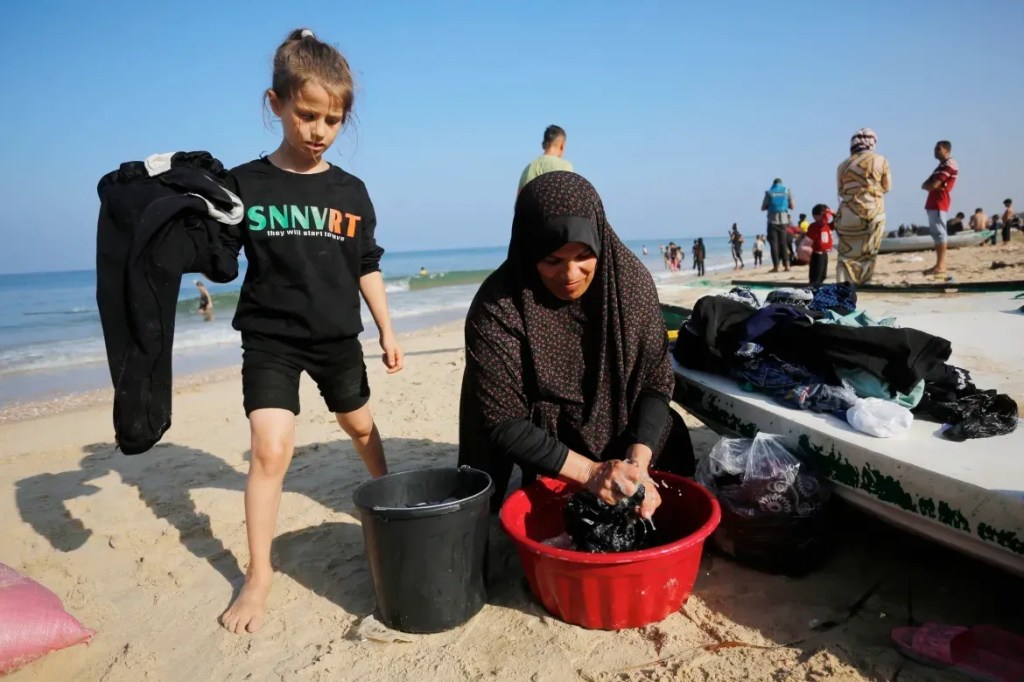
In southern Gaza, families have been forced to wash clothes and dishes in seawater as clean water simply runs out. As of the original report in October 2024, the situation was already dire. Since then, it has only deepened — and widened.
For weeks, residents in the north were told to evacuate south as Israeli strikes and incursions intensified. The result: massive internal displacement, massive infrastructure destruction, and a humanitarian crisis of a scale often labeled unimaginable. People have lost not just homes, but the basic elements of daily life: water, power, sanitation, hygiene.
“I took a pause from what is happening in Gaza and entered the sea to be able to breathe,” said Ibrahim Sulieman of Gaza City. On the beach of Deir Al Balah, he washed himself and his clothes. “It is the only way to clean myself and pray.”
Sulieman and his 37 family members are sheltering in a UN-run school. Meanwhile, others like Yasmin Ataar, a mother of three, are watching the reality sink in. “I have nowhere to go to wash these clothes, or to dry them. I am making my children wear damp clothing,” she said. Her daughter has kidney problems; clean water isn’t just convenience — it’s survival.
Beyond Seawater: What’s Changed Since October 2024
1. Systemic destruction of water infrastructure
Before the escalation, Gaza relied partly on pipelines from Israel and on desalination and aquifer extraction. According to UNICEF, by late 2024 the WASH (Water, Sanitation and Hygiene) situation was critically desperate: “families’ basic needs for water, sanitation, and hygiene are not being met.” UNICEF+1
Fuel shortages continue to paralyze pumping stations and desalination plants. Municipal wells are shut down or severely reduced. In the October 2024 humanitarian update from United Nations Office for the Coordination of Humanitarian Affairs (OCHA), it was noted that eight private water providers had ceased operation in Gaza City due to a lack of fuel, while municipal wells had limited production. OCHA
2. Daily water rationing falls far below standards
For large parts of the population, available water has plummeted to unthinkable levels. One report from late 2025 noted that water provision in Gaza had fallen to ~8.4 liters per person per day — far below the minimum of 15 liters recommended by the World Health Organization in emergencies. TIME
3. Overflowing sanitation crisis
As water infrastructure fails, untreated sewage and wastewater have spread. According to assessments, dozens of pumping stations and many sewage treatment plants have been damaged or destroyed. Raw sewage infiltrates aquifers; environmental contamination has gone beyond a temporary crisis into long-term risk. Wikipedia
4. Health consequences mounting
The lack of clean water and functional sanitation has direct human costs. In southern Gaza alone, one aid organisation reported that diseases caused by poor hygiene and sanitation now account for 70 % of outpatient consultations. Doctors Without Borders
Children, pregnant women, and displaced families living in tents or schools are particularly vulnerable. Forced to rely on seawater or heavily contaminated water, many are squeezed into already overcrowded shelters. Clean laundry, safe water, and hygiene become luxury tasks rather than routine.
5. Displacement and the collapse of homes
Much of northern Gaza was evacuated or destroyed. People fleeing from their homes carry very little and are often housed in schools, makeshift shelters, or shared spaces. Many of these shelters lack proper laundry, drying, or hygiene facilities. As Ms Ataar’s story shows, children are wearing damp clothes; the concept of “washing clothes” becomes almost psychologically impossible under such conditions.
6. International accountability and water as a weapon
Human rights organisations such as Human Rights Watch (HRW) have weighed in. In December 2024, HRW released a report accusing Israeli authorities of denying Palestinians in Gaza the water needed to survive — characterising it as acts of genocide and extermination. Reuters+1 The allegations stem from observed damage to water pipelines, denial of fuel, and the collapse of plumbing while civilians were expected to survive.
7. Aid access remains erratic
While a ceasefire was reached in October 2025, enabling some aid flow, humanitarian organisations emphasise that safe, predictable access remains far from guaranteed. Front page – US+1 Without water, laundry is not just dirty clothes — it’s the absence of dignity and health.
The Laundry Reality: What This Means Day-to-Day
Imagine you’re a mother in Gaza, your housing destroyed, your family displaced. You have no proper washing machine, no clean water, no safe place to dry clothes. Dirt, sweat, body fluids build up. You find yourself at the beach, washing clothes in seawater, salt drying stiff and scratchy. You cannot dry the garments properly — so children wear damp clothes, increasing risk for skin infections and respiratory problems.
That’s the everyday reality now. Laundry isn’t a chore — it’s a burden. It’s a symptom of collapse.
When the cleaning agent isn’t available, when the rinse water is filthy, when the drying process is impossible, clothes become vectors of disease. This is not just a personal laundry story; it is public‐health, it is human‐rights, it is infrastructure failure.
Why Laundry and Hygiene Still Matter
- Health: Without clean clothes, without drying, without safe water, skin infections, fungal infections, and other hygiene-related diseases spiral. In hospital settings, even basic hygiene can fail without water. The WHO stated: “Water is needed to ensure sanitary conditions on inpatient wards… It is essential for the prevention of hospital associated infections.”
- Dignity: Laundry is part of daily life, part of normalcy. When you can’t wash clothes, you lose one of the last connections to a normal routine.
- Stability: Clean water, sanitation, and hygiene services are foundational for rebuilding society. If they collapse, entire generations suffer.
- Long term: Infrastructure damage now threatens years of recovery ahead. Environmental contamination, dried out systems, are harder to rebuild.
What Must Happen — and What’s Next
Immediate needs:
- Rapid fuel access to power wells and pumping stations
- Clean water deliveries, safe water points
- Mobile laundry or hygiene units in shelters
- Sanitation repair, sewage treatment restart
Short to mid-term:
- Repair pipelines and wells
- Rebuild desalination capacity
- Reconstruct laundry and washing facilities in shelters and homes
Long-term:
- Rebuild Gaza’s water infrastructure with resilience to future shocks
- Restore sanitation capacity and mine the environment for hazards
- Establish regular laundry access as part of humanitarian recovery
Final Spin
When we talk about “laundry,” we imagine clean clothes, fresh scent, simple chores. In Gaza, laundry has become a lens into collapse — the seawater rinse, the damp clothes, the absence of machines. It’s a daily reminder that when infrastructure fails, even the smallest human tasks become impossible.
Let’s remember the voices of Ibrahim Sulieman and Yasmin Ataar. Let’s push for clean water, functional schools, functioning machines, and dignity restored. Because laundry matters. Not just for clothes — for life.


 The Laundry Club Blog
Leave a comment