Welcome back to The Laundry Club Blog, where we don’t just hang up the linens—we dig deep into their stories. Today, we’re wringing out a history soaked in sacrifice, resilience, and the invisible hands that scrubbed the stains of war. This is the tale of blood, sweat, and linen—laundry during wartime, through the eyes and aching backs of those who toiled behind the lines.
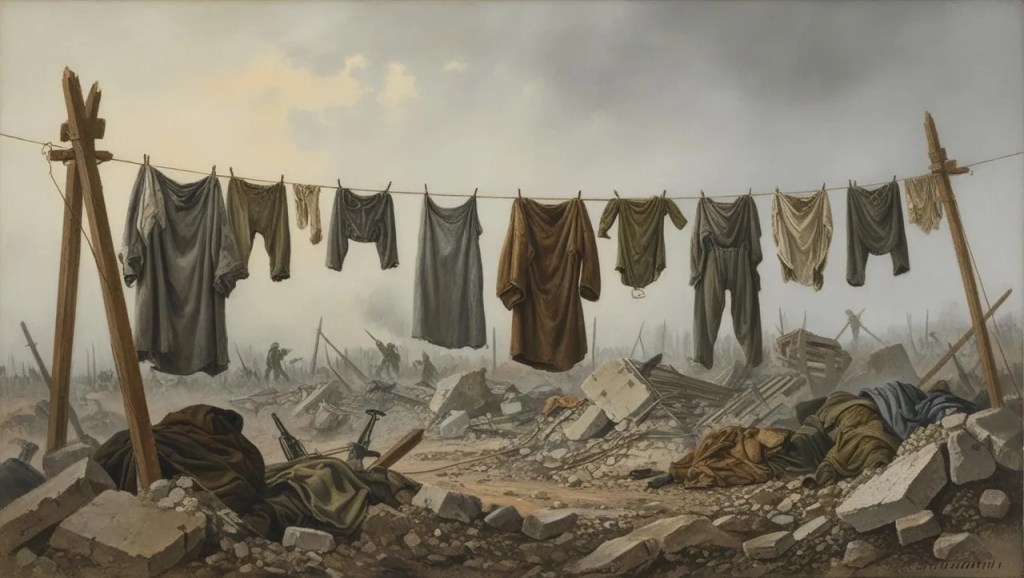
The Forgotten Frontline
When we think of war, we imagine trenches, tanks, and strategy. But behind every soldier, there was someone laundering the mud-caked uniforms, boiling the lice-infested undergarments, and rinsing out the bloodied bandages. Laundry might not make the headlines, but in wartime, it was a vital operation. In the chaos of battle, clean fabric wasn’t just about comfort or appearance—it meant survival.
Let’s unfold the linens of history, one war at a time.
Ancient War and Water
Even in ancient times, laundry was no stranger to war. Roman military camps included slaves and camp followers who performed essential services—among them, washing garments and cleaning wounds. Tunics soaked in sweat and blood were scrubbed in rivers, pounded on rocks, and hung out under the brutal Mediterranean sun.
In feudal Japan, samurai wives or the lower-ranking attendants known as ashigaru often doubled as laundresses. There was spiritual symbolism in cleansing blood from garments—it was an act of honor, of restoring purity after battle.
The American Civil War: Wash Tubs and Weary Hands
In the American Civil War, laundresses were officially hired by the military, often as camp followers. These women weren’t just washing—they were cooking, nursing, and sometimes even spying. They charged for their work, but the labor was brutal. Washing meant hauling water, boiling it over open fires, scrubbing each item by hand with lye soap, and hoping the soot didn’t stick to the whites.
They washed not only soldiers’ uniforms but also the bloody bandages returned from the battlefield. Reusing cloth meant it had to be clean—truly clean. A poorly laundered bandage could mean death by infection.
Laundresses often faced dangers themselves—disease, displacement, or abuse from the very troops they served. Yet they remained, often unsung, preserving the dignity and health of regiments with every rinsed-out rag.
Victorian Mourning and Laundry
During the Crimean War and later in the Boer War, British women served as nurses and laundresses. The custom of mourning clothes meant black dye—a dye infamous for bleeding and fading. Widowhood was practically an industry during these times, and laundresses who understood how to clean dark fabric without fading it were in high demand. Imagine washing a grieving mother’s gown without letting it lose its luster. It wasn’t just laundry—it was grief management.
World Wars I & II: Women, War, and Washtubs
Both World Wars put women to work—on the frontlines and at home. In field hospitals across Europe, Red Cross volunteers boiled bandages, soaked uniforms, and dealt with the horror of trench-footed socks and lice-infested wool.
During WWI, French laundresses known as blanchisseuses were stationed in small villages and mobile camps. These women often risked their lives hauling linens through bombed-out countryside just to find clean water sources.
In WWII, the role of laundry became even more mechanized and militarized. The U.S. Army had mobile laundry units—actual trucks equipped with washers, dryers, and ironing stations. A single mobile unit could launder over 600 pounds of clothing a day. The men (and a few women) assigned to these units were often dismissed as unimportant, but their role was critical in controlling disease and maintaining morale.
Meanwhile, on the home front, civilian women took on the laundry of entire communities. With so many men deployed, women ran large-scale laundry co-ops, washed neighbors’ uniforms, and kept the factories’ linens turning.
Soviet Women and the Cold Duty
In the USSR, women were highly involved in wartime labor—including laundry. Soviet nurses and field workers were tasked with not only tending to wounded soldiers but also laundering their soiled uniforms and hospital bedding in below-zero conditions. They melted snow for wash water and used whatever fuel they could find to boil water over makeshift fires. For many, frozen fingers and frostbitten toes were the price of clean cloth.
This wasn’t just housework; it was a brutal endurance test. The work was unending. As one Soviet nurse recalled, “The smell of blood never left the steam.”
Vietnam and Korea: Jungle Rinse Cycles
During the Vietnam and Korean Wars, laundry became a fusion of necessity and improvisation. Many local women were hired to launder American soldiers’ clothing. In Vietnam, mama-sans used traditional river-washing methods—beating fatigues on stones and using local herbs for scent. Sometimes they became surrogate mothers to the soldiers.
But this created controversy. Laundry was a point of vulnerability—there were cases of clothing being sabotaged or stolen. Uniforms were more than just garments; they were gear, camouflage, identity. The trust between soldier and laundress was delicate.
A Stitch in Resistance: Underground Laundry
In various resistance movements—such as in Nazi-occupied France or fascist Italy—laundry was also a cover for espionage. Secret messages were sewn into hems or pinned behind lapels. Laundry lines became codes. A red handkerchief might mean danger. Two black socks = “Safe to proceed.”
Laundry wasn’t just a domestic duty. It was silent resistance.
Modern Warfare and Clean Operations
Today, laundry services in war zones are outsourced or handled by military contractors. There are large-scale, automated systems that sterilize hundreds of pounds of laundry per hour. In conflict zones like Iraq and Afghanistan, the logistics of laundry are outsourced to companies like KBR or Fluor.
But even now, laundry is about more than cleaning—it’s about psychological relief. The scent of freshly washed clothing can remind soldiers of home, of humanity.
In refugee camps and crisis zones, laundry is still a powerful act of reclamation. NGOs now distribute “dignity kits”—including soap and fabric sanitizer—to displaced women, recognizing that the ability to wash one’s clothes and linens is an essential form of self-respect and healing.
The Emotional Toll: Scrubbing Out Trauma
To wash the blood from a uniform is to relive the wound. Wartime laundry is not a sterile act—it’s deeply emotional. Imagine a nurse boiling the same bandages night after night, knowing some of those stains belonged to the young boy she fed soup to just hours before.
Laundry during war carries weight: the weight of duty, memory, grief, and resilience. It’s an invisible labor, but one that binds the frontlines to the home front.
And sometimes, what is laundered is not the fabric—but the soul.
Final Spin
In every war, there were those who carried rifles—and those who carried washbuckets. The unseen labor of laundering through gunfire, grief, and grit deserves its place in the history books. At The Laundry Club, we honor the wrung-out, the weathered, and the forgotten—because even battered cloth bears witness. In the steam of every boil and the snap of every line-dried sheet, there is resilience. There is memory. And we will keep telling their stories.
Support The Laundry Club Blog: If you believe everyday labor deserves a place in history, help sustain the stories that rarely make it to the front lines—but always stood beside them.

 The Laundry Club Blog
Leave a comment