Laundry: the very word conjures up images of cleanliness, care, and daily routine. Yet beneath the rhythmic slosh of water and the scent of fresh linens lies a far older, darker undercurrent. Across the globe, laundry has been deeply entwined with ritual magic, protective charms, and yes—curses. From whispered hexes in village wells to protective laundering rites for newborns and soldiers, the act of washing clothes has long held a place not only in the domestic sphere but in the supernatural one as well.
Welcome to a world where the laundry line stretches across cultures and centuries, soaked in symbolism, spellwork, and the arcane.
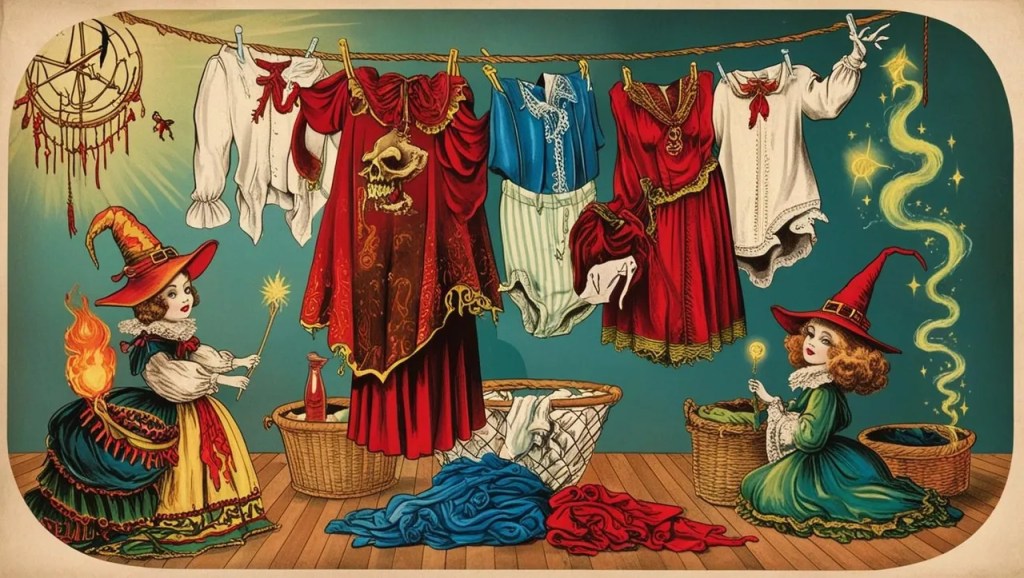
The Witch at the River: A Global Archetype
In many cultures, washerwomen were feared as much as they were pitied. They were often depicted as isolated figures, stooped beside a river, beating clothes with rhythmic fervor. This archetype pops up across continents:
- In Ireland, the bean nighe (“washerwoman”) is a spectral hag said to appear at the river’s edge, washing the bloodied clothes of someone about to die. Seeing her was an omen of impending death, and if you could catch her, she might grant you a wish or tell you the name of the doomed.
- In Scotland, the caoineag (a weeping woman) performs a similar role, laundering the garments of warriors fated to fall in battle.
- Among Yoruba traditions in West Africa, the river goddess Oshun is associated with fresh water, beauty, and fertility, and her rituals often include the washing of sacred white garments.
Whether feared or revered, these figures blend the mundane act of washing with divine or mystical significance. The line between human and spirit becomes blurred at the water’s edge.
Curse-Washing and Binding Spells
In ancient and medieval Europe, washing clothes could be an act of both magic and malice.
- In Italy, folk witches known as streghe were said to wash ritual cloths in spring water under the full moon, imbuing them with protective or harmful energy depending on their intent.
- In Eastern Europe, it was believed that washing a person’s clothes at night invited misfortune, illness, or death upon them. The water, now filled with “essence,” could be collected and used to cast spells against them.
- Germanic traditions sometimes included the binding of garments with knots to create or break emotional bonds. Love spells were tied—quite literally—into undergarments.
- In Russia, hexes could be hidden in a person’s dirty laundry. To curse someone, one might steal an article of clothing, especially undergarments or headwear, believed to hold the most personal energy, and perform a ritual washing while chanting ill wishes.
The use of soiled garments in hexing illustrates the ancient belief that personal items retain spiritual residue. The more intimate the garment, the more potent the spell.
Protective Laundry Magic
Not all laundry lore is dark. In fact, many cultures developed protective washing rituals to ward off evil and ensure health and prosperity.
- In Korea, traditional postpartum care includes careful laundering of the mother’s and baby’s garments, often using mugwort-infused water to ward off evil spirits.
- Ashkenazi Jewish tradition has the custom of laundering garments before certain high holidays, not only for physical cleanliness but as a symbolic act of spiritual renewal.
- In Hoodoo and Southern conjure practices, adding ingredients like Florida Water, salt, or specific herbs to laundry rinse cycles could cleanse a household of negative energy. Clothes dried in direct sunlight would be further empowered.
- In India, washing clothes during an eclipse is avoided, as the time is seen as spiritually impure. However, laundering garments immediately after the eclipse ends is seen as a way to remove the lingering effects of any inauspicious energy.
These practices reveal a belief in laundry as not only a physical cleansing act but a sacred ritual.
Laundry as Divination
In some regions, the laundry itself became a form of augury.
- Italian and Romanian folklore includes beliefs about who would marry next, determined by the way garments hang or fall on the line. If a shirt fell off, it could mean the wearer would soon experience misfortune or receive a surprise visitor.
- Turkish coffee readers occasionally turn to garments as tools for dream interpretation or future-casting. A wet cloth drying too slowly might indicate bad luck lingering around a person.
- In Appalachia, old-timers believed that if a white shirt turned yellow on the line, the wearer was being gossiped about or cursed.
This fascinating offshoot connects the seemingly dull act of laundry with attempts to read the future, revealing how even the simplest chores become imbued with mystery.
Gender, Power, and the Hidden Magic of the Domestic
The link between laundry and witchcraft is not incidental. Historically, women performed the majority of laundry labor. This gave them access to a powerful medium: the intimate clothing of others. In a time when a lock of hair or drop of blood could anchor a spell, a person’s shirt or undergarments were magical gold.
Washing and cursing alike were veiled in the “invisibility cloak” of domestic labor. It was one of the few areas where women, often excluded from public or religious authority, could exercise significant control—even if their power went unacknowledged, feared, or labeled heretical.
This tension gave rise to superstitions warning against washing on holy days, or the idea that witches did laundry at night to avoid detection.
Laundry, in this light, becomes a lens into gender dynamics, belief systems, and cultural taboos.
The Haunted Laundromat: Modern Echoes of Old Beliefs
Even today, stories of haunted laundromats or cursed washing machines persist. Ghost hunting forums are peppered with tales of:
- Machines turning on by themselves
- Clothing returning with unfamiliar scents
- Apparitions seen through steam or spinning dryer windows
While these accounts are largely anecdotal, they speak to a deeper, almost instinctual connection between water, clothing, and the otherworldly. Our clothes bear our scent, our skin cells, and our stories. It’s no wonder they remain a focal point for both protection and peril.
In some urban magic practices, it’s still common to place sigils inside pockets or to chant while folding clothes—embedding intention into fabric.
Spell Recipes and Cultural Touchstones
Here are a few examples of laundry-adjacent spellwork found throughout the world:
- Brazilian Macumba: Washing clothes in river water mixed with certain herbs like arruda (rue) can remove bad luck or “eye” energy (mal de ojo).
- Haitian Vodou: Garments are sometimes ritually washed in sacred ceremonies, particularly during initiations, using specific infusions blessed by a mambo or houngan.
- Sami (Indigenous Northern Europe): Clothing was rarely washed during certain moon phases, especially if the garment belonged to a healer or spiritual worker. The water from such garments was believed to carry both healing and harmful potential.
- Mexican Curanderismo: A cleansing (limpia) may involve washing a person’s clothes in salt water, then burning or burying the water-soaked fabric as a form of spiritual disposal.
In all these cases, the symbolic connection between fabric, the human body, and spirit is paramount.
Final Spin: Why It Still Matters
Why do these beliefs persist? Because laundry is intimate. It connects us to our bodies, our environments, and each other. Clean clothes represent safety, respect, order. Dirty ones speak of secrets, illness, or vulnerability.
To wash someone’s clothing is to interact with their essence. To curse it is to harm them without touch. To bless it is to wish them well, cloak them in good fortune, or guard them from harm.
So the next time you sort your whites or fold a stranger’s forgotten sock at the laundromat, take a moment. The water remembers. The cloth listens.
And who knows? Maybe your detergent is doing more than just stain-lifting.
Support The Laundry Club Blog—because magic doesn’t just happen at midnight; sometimes it starts in the wash

 The Laundry Club Blog
Leave a comment