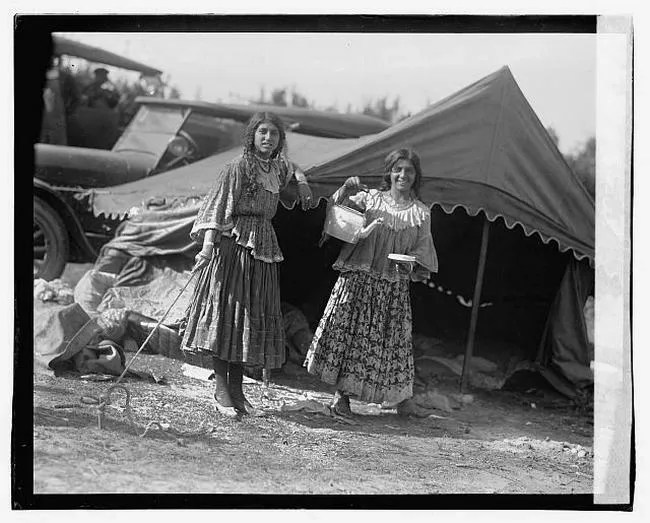
In the world of the Romani people, cleanliness is more than a matter of personal hygiene—it’s a deeply rooted part of their spiritual and cultural practices. Among the traditions passed down through generations, the act of washing clothes holds profound significance, especially when it comes to the separation of male and female garments and the division between the upper and lower body. This custom isn’t merely practical; it’s governed by the laws of marime, a set of taboos that regulate every aspect of a Gypsy’s life, including the washing and drying of clothes.
At the heart of Gypsy laundry rituals lies the essential rule: wash male and female clothing separately. This division is part of a greater set of principles that requires clothes worn above the waist to be washed and dried apart from those worn below the waist. Shirts, blouses, and jackets—garments of the upper body—must never be mixed with trousers, skirts, underwear, or socks, which belong to the lower half. This practice underscores a fundamental belief in the separation of the body’s purity, the upper half being deemed clean and sacred, and the lower half, particularly the genitals and feet, considered impure. By maintaining this separation in laundry, Gypsies preserve their cultural customs and ensure spiritual balance within their households.
The Laws of Marime: Purity and Contamination
The laws of marime are more than a set of practical guidelines; they are a system designed to safeguard against contamination, which is viewed as a serious transgression in Gypsy culture. Marime refers to a state of impurity that can affect both individuals and objects. For example, a man must never walk beneath a clothesline where women’s clothes are hanging to dry, as this is seen as a form of contamination. This belief extends to clothing itself—if any item becomes polluted, it must be discarded. To avoid such contamination, those who can afford it may own four separate washing machines: one each for male clothing, female clothing, upper-body garments, and lower-body garments.
The Spiritual Underpinnings of Laundry Rituals
These seemingly simple rules have a spiritual origin. The waist is considered a dividing line between the upper and lower body, symbolizing the boundary between purity and impurity. The Romani word for waist, maskar, reflects this duality, as it can also mean the spatial center of anything. By respecting this boundary, Gypsies maintain a sense of spiritual and physical harmony, keeping their bodies, homes, and communities free from pollution.
The importance of cleanliness goes beyond laundry—it extends to how Gypsies interact with the world around them. For instance, when a Gypsy touches their lower body, they must wash their hands immediately to avoid spreading impurity. The same rule applies to any object touched by the feet, such as shoes or floors. These items are deemed contaminated and must be treated with care. This belief influences even the way bedcovers are used: to prevent accidental contamination, Gypsies mark the bottom end of bedcovers with a button or ribbon to ensure that the foot-end never touches their face.
Contamination of Non-Gypsies: A Cultural Divide
For Gypsies, non-Gypsies (or “Gadje”) are often seen as perpetually contaminated. This perception is tied to the Gypsies’ belief that non-Gypsies lack the same awareness of purity. For example, a non-Gypsy might neglect to wash their hands after using the restroom or might mix their underwear with face towels, treating them as equally clean. In the eyes of the Gypsy community, these seemingly innocent actions violate the sacredness of cleanliness and expose a lack of respect for the body’s separation into pure and impure domains.
Such taboos and rituals create a clear distinction between Gypsies and non-Gypsies. They emphasize the importance of maintaining cultural identity and traditions, even in a world where modern practices often blur the lines between what is considered pure and what is deemed dirty. For the Romani, the act of washing clothes is not just a matter of cleaning fabric—it’s a sacred ritual that preserves their sense of self, their spiritual well-being, and their connection to an ancient way of life.
A Reflection of Cultural Continuity
Despite the challenges of living in the modern world, the Gypsy approach to laundry and cleanliness remains an important part of their cultural fabric. The division between male and female clothing, and the sacred separation of upper and lower body garments, reflects a deeper commitment to maintaining purity and spiritual balance. It is a practice that, while seemingly simple, carries with it centuries of tradition, belief, and respect for the sacredness of the body and the home.
In the end, the Gypsy laundry is more than just a chore—it’s a sacred ritual, a reflection of deep cultural values, and a way to preserve a sense of identity in a rapidly changing world. For those who adhere to the laws of marime, every wash and every fold is an act of reverence, ensuring that the purity of the body and spirit is upheld for generations to come.
Final Spin:
The Romani approach to laundry is a vivid reminder that washing clothes can transcend the physical and reach into the spiritual. In every rinse, separation, and careful fold lies a centuries-old code of respect for the body, the home, and the divine order of purity. While the modern world may see laundry as mundane, for the Gypsies it remains a sacred dialogue between cleanliness and the cosmos—proof that even soap and water can carry the weight of the soul.
Support The Laundry Club Blog — because sometimes, the act of washing clothes reveals far more than stains; it reveals who we are.

 The Laundry Club Blog
Leave a comment