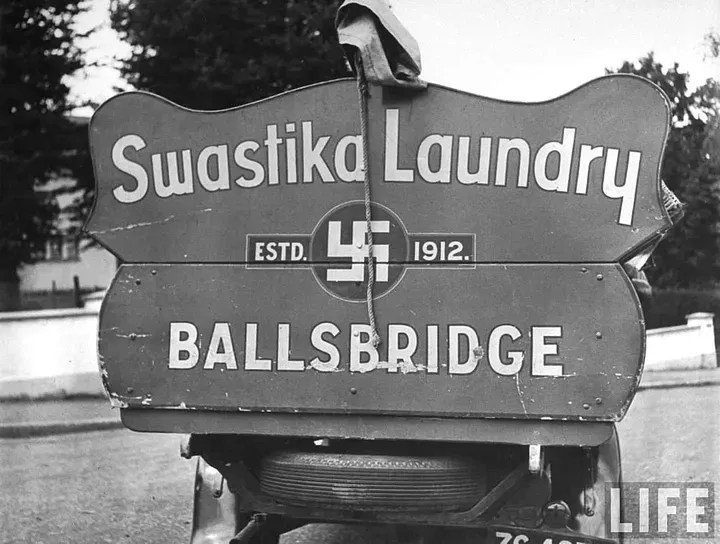
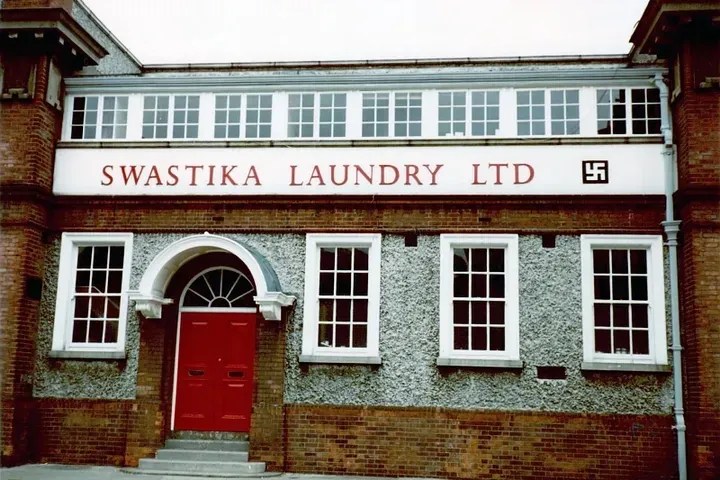
The Swastika Laundry, a once-thriving business, remains an interesting footnote in history. The company used an ancient symbol, but the Nazis later co-opted it. They operated out of Dublin, Ireland, and played a prominent role in the city’s social and economic fabric before the rise of fascism made its name and logo untenable.
Origins and Early Success
John W. Brittain founded the Swastika Laundry in the Ballsbridge neighborhood of Dublin in 1912. He was a pioneer in laundry development in Ireland, already having helped found the Metropolitan and White Heather Laundry firms in Dublin at the turn of the last century. Brittain originally planned to name his company Olympic Laundry, but changed it after visiting the Great Industrial Exhibition in London, where he bought a figurine of a black cat with a swastika around its neck. This ancient sign associated with good fortune, prosperity, and wellbeing captivated him, and led him to reconsider his company’s name.
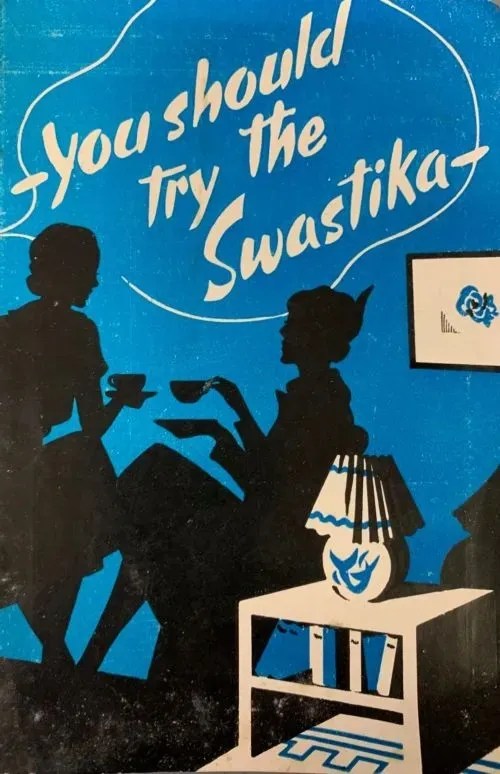
The company informed the public it, “stands of a beautiful site of 3 ½ acres, surrounded by stately trees and fresh green lawns, free from smoke and dust. Linen dressed by us is redolent of fresh air and sunshine”. They emphasized the purity of the cleaning process. They didn’t use injurious substances like bleaching powder, caustic soda, caustic potash, or oxalic acid, and the linen was “cleansed snowy white by Vartry water [and] sterilized and disinfected by Electric Fluid made on the premises by the only plant of the kind in Ireland.”
Brittain liked the swastika as symbolizing good fortune, becoming a popular decorative motif in the West during that time. Therefore, the company used the swastika emblem prominently in its branding, placing it on everything from laundry bags to its delivery vehicles.
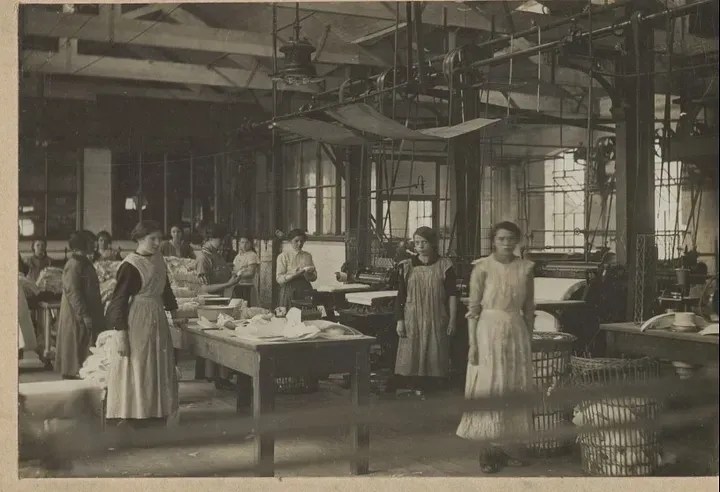
At its peak, the Swastika Laundry washed around 50,000 shirts a week and was the largest launderer of shirts in Europe. In 1957 alone, they laundered 1,670,000 shirts and 11 million other articles. The company used 50 tons of soap and 2½ thousand tons of coal a year to keep the boiler going for hot water and steam. Swastika had as many as 600 employees, mainly women.
The Swastika Laundry Logo
The Swastika Laundry’s logo featured a simple design with the swastika symbol prominently displayed. It was a striking image that resonated with the company’s emphasis on reliability, cleanliness, and high-quality service. The company often incorporated the swastika into the logo, framing it in a square or circular shape to ensure easy recognition by customers. The symbol had purely positive connotations, and advertisers and branders often incorporated it with no negative associations.
Competitors in the Early 20th Century
During the early 20th century, the laundry business in Dublin was competitive. Several laundry companies also operated within the city, including the Dolphin Laundry, Sunlight Laundry, and North Dublin Laundry. These companies offered similar services to the Swastika Laundry and were well-regarded for their commitment to high-quality laundering and customer service. While these businesses did not adopt the same kind of distinctive branding, they served a loyal customer base across Dublin.
The Red Electric Delivery Vans
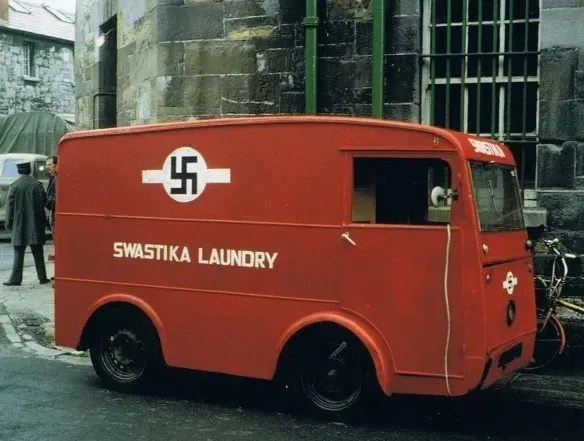
One of the unique aspects of the Swastika Laundry’s business model was its fleet of electric delivery vans. They painted their vans bright red and featured the swastika logo prominently on their sides. People could see these vans all over Dublin as they transported freshly cleaned laundry to customers. The Swastika Laundry established a reputation for efficiency by using these electric vans. This distinguished them from their competitors, who usually relied on horse-drawn carriages or other traditional transportation methods. Their red electric vans became part of the Swastika Laundry’s identity, showing their commitment to innovation and modernity.
The vans had a range of 30 miles, and where the constant stopping and starting would have caused internal-combustion engines to break down, it wasn’t a problem for electric ones.
The Swastika’s Pre-Nazi Use: A Universal Symbol of Good Fortune
Before the Nazi regime forever altered its meaning, many cultures used the swastika throughout history. Dating back over 5,000 years, people revered the swastika as a symbol of good luck, prosperity, and wellbeing. The swastika gets its name from the Sanskrit word svastika, which roughly translates to “well-being” or “good fortune.”
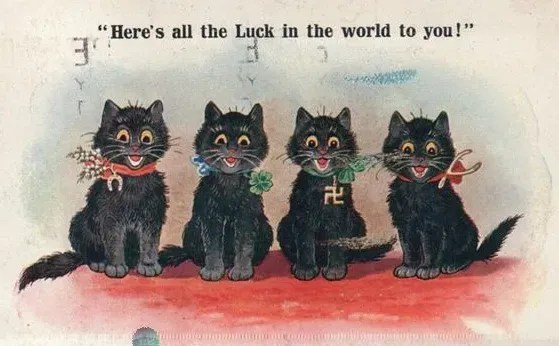
In Hinduism, Buddhism, and Jainism, the swastika was and remains a sacred symbol, often found in temples, religious texts, and artifacts. It represents various concepts, such as eternity, the universe, and the cyclical nature of life, including reincarnation. The swastika also frequently appears in ancient Chinese and Japanese cultures, symbolizing balance and harmony. Native Americans, too, used the symbol as a sign of the four winds or the four cardinal directions.
In the early 20th century, the swastika became popular in Western culture as a decorative motif and a good luck charm. It appears in architecture, fashion, and advertising, and branding — including the Swastika Laundry. For instance, the Boy Scouts, the Finnish Air Force, and even Coca-Cola used the swastika as a symbol of positive energy and fortune.
There’s actually a bit of folklore that Hitler borrowed the logo of this Irish Laundry company. His elder half-brother, Alois Hitler Jr. visited Dublin and eloped with an Irish woman, Bridget Dowling. Dowling says Adolf Hitler lived with them in Liverpool in 1912–13. Her hometown of Dublin was just a short ferry trip across the Irish Sea. Certainly the laundry company’s black and white swastika and roundel on a red field bears a striking resemblance to the Nazi flag.
The Rise of the Nazi Party and the Dilemma
In the 1930s, as Adolf Hitler and the Nazi Party rose to power in Germany, the swastika became indelibly associated with fascism, anti-Semitism, and hatred. The Nazi Party adopted a modified version of the swastika, rotated at a 45-degree angle, as its primary emblem, and featured it prominently on its flags and propaganda materials. The symbol that had once represented good fortune and prosperity was now linked with atrocities, violence, and war.
As the Nazi party began to gain international attention, the Swastika Laundry found itself in a difficult position. There were some clear differences between the company’s branding and the Nazi flag. The laundry used a more traditional version. Still, many people began to associate the business with the fascist movement. The red color of the Swastika Laundry’s vans further compounded the issue, as it resembled the red, white, and black Nazi flag.
Faced with growing public pressure and confusion, the Swastika Laundry made adjustments to avoid being associated with the Nazis. In 1939, as World War II loomed, the company made a concerted effort to distance itself from the controversial symbol. While the company continued to use the name, it downplayed the swastika in its branding and advertising materials. They focused instead on their reputation for quality service.
The Decline and Closure of the Swastika Laundry
Despite the company’s attempts to disassociate itself from the swastika, the negative connotations of the symbol persisted. As World War II raged on and the atrocities of the Nazi regime became widely known, the use of the swastika in any form became increasingly unacceptable in the West.
Although the Swastika Laundry continued to operate throughout the war, the damage to its brand was considerable. Public perception of the symbol was irreversibly altered, and the association with the Nazi regime proved too strong to overcome. In the post-war years, the Swastika Laundry struggled to maintain its customer base and relevance.
Eventually, the company ceased operations in 1987. While it remained a fixture in Dublin for several decades, the negative associations with its name and branding ultimately contributed to its decline. The company quietly closed its doors, leaving behind a legacy that is as much a lesson in the power of symbols as it is a testament to the changing social and political landscape of the 20th century.
The Legacy of the Swastika Laundry
Today, the story of the Swastika Laundry serves as an intriguing case study of how symbols can change over time. It began as a successful laundry company with a symbol of good fortune and prosperity at its heart. But ultimately that symbol was appropriated by a violent regime. Museums preserve some remnants of the company, such as the laundry bags and the red delivery vans, providing future generations with insight into this unique piece of Dublin’s history.
In 2005, developers transformed the site of Swastika in Ballsbridge into an office building known as The Oval. The Laundry’s chimney, now a protected structure, survives, but with the logo removed. Even now, the story of the Swastika Laundry evokes a mixture of nostalgia for a bygone era and recognition of the powerful, and often unpredictable, impact of history on everyday life.

 The Laundry Club Blog
Leave a comment