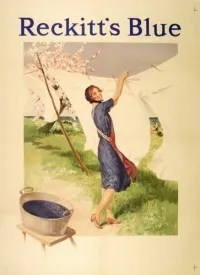
Bluing, Dolly Blue, and the Secret of Reckitt’s Blue Bags
Before modern detergents and optical brighteners made whites gleam with minimal effort, there was a little laundry secret known as bluing. Yes, the mysterious blue bag you stirred into the final rinse water on washday. This wasn’t just for show—it was the trick to making linens look truly white, masking any hint of yellow.
Factory-made bluing emerged in the mid-19th century, a commercial version of older home recipes that went by names like stone blue, fig blue, or thumb blue. The idea was simple: a dash of ultramarine in the rinse water could make household linens look brighter, fresher, and cleaner than white itself.
Reckitt’s Blue Bags: Penny Cubes of Magic
By the mid-20th century, Reckitt’s blue bags were famous across the UK and beyond, sold in tiny penny cubes to be wrapped in muslin or flannel—or already bagged and ready to go. Names changed over the years: Reckitt’s Blue, Bag Blue, Paris Blue, Crown Blue, Laundry Blue, and Dolly Bags. Ingredients? Synthetic ultramarine and baking soda, each square weighing about an ounce.
Reckitt’s wasn’t just any laundry company. They had been working with blue and starch in Hull before importing French ultramarine in the 1850s. Victorian advertising even claimed royal laundries used Reckitt’s, and Eliza Elder, laundress to the Prince of Wales, swore by it:
“I have been laundress to the Prince of Wales for several years, and I consider Reckitt’s Paris blue is the best I ever used, and is undoubtedly greatly superior to the old-fashioned thumb or dark blue.” – April 12, 1873
At one penny an ounce, this little ultramarine wonder wasn’t just for laundry—it ended up in paint, dyes, and even ink across the globe. Today, some still use it in Caribbean rituals to dye water blue for magical purposes.
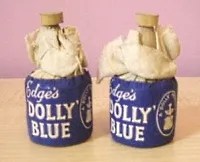
Dolly Blue and the Cute Little Stick
By 1900, Dolly Blue from north-western England came in tiny bags with a stick poking out, perfect for dipping into rinse water. The stick, a nod to the washing dolly, also inspired playful advertising featuring little girl dollies. William Edge & Sons, the manufacturer, fought two court cases (1900 and 1911) to protect the brand—a legal legacy still cited in intellectual property law today. Edge & Sons merged with Reckitt & Colman but closed in 1968.
Stone Blue, Fig Blue, and Blue Starch: The Pre-Chemical Days
Before synthetic chemicals, people relied on indigo or powdered smalt (ground glass with cobalt) to brighten whites. Mixed with starch and sometimes other additives, these were formed into lumps: stone blue, fig blue, thumb blue, or Queen’s blue. Powdered blue was sold by weight, often mixed with extra starch depending on the fabric.
An 18th-century housekeeping manual gave this advice for whites:
“Moisten the quantity of starch you want to use…put as much stone blue as necessary…let the whole boil together a quarter of an hour…keep stirring it…starch ought to be boiled in a copper vessel…”
Finer fabrics needed extra care. Lace collars? Sponge carefully with water infused with gum-Dragon and fig-blue. Elizabethan fashion even used blue starch to tint ruffs. Though banned briefly by Queen Elizabeth in 1595 for “immoral” excess, blue starch returned to households and stayed a laundry essential for centuries.
Where to Find Laundry Bluing Today
If you want to give your whites a vintage boost or just experiment, a few brands still sell bluing:
- Dolly Blue – Classic UK brand, mostly online or specialty stores.
- Mrs. Stewart’s Liquid Bluing – Widely available in the US.
- Robin Blue – Popular in India and Pakistan, now marketed as a post-wash whitener.
Pro tip: one tiny capful in the rinse water is enough to make your whites pop. Too much blue and, well…you might end up with a very fashion-forward tint of Smurf.
DIY Historical Bluing Experiment
For a fun vintage touch:
- Fill a basin with clean water.
- Drop in a tiny piece of laundry blue or a few drops of liquid bluing.
- Swirl gently.
- Add your whites, let them soak for a few minutes, then rinse and dry.
You’ll have linens bright enough to make any Victorian laundress jealous. Bonus: it’s a perfect conversation starter at the next laundry party.
Final Spin:
Remember, the only thing that should ever be blue in your life is the laundry bluing—everything else deserves a little warmth, a little care, and a gentle spin in the dryer of kindness.
Support my work: paypal.me/TheLaundryClub

 The Laundry Club Blog
Leave a comment